







.
AI_133px.jpg
ai
Artificial Intelligence
.
biotech
biotech
Biotechnology and Synthetic Biology
.
cryptography
crypto
Cryptography and Computer Security
.
Sustainable-Energy-Technologies_133px.jpg
energy
Energy Technologies
.
materialscience
nano
Materials Science
.
neuroscience
neuroscience
Neuroscience
.
Quantum Technologies
.
semiconductor
semiconductors
Semiconductors
.
space
space
Space

KEY TAKEAWAYS

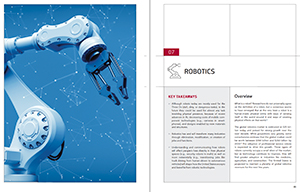
•   Artificial intelligence holds significant potential to advance complex robotic systems, but the speed of future advances will depend on the availability of high-quality training data and the systematic integration of data-rich foundation models, simulated interactions between robots and their environment, and understanding of the real physical world.

•  Humanoid robots show promise for specialized industrial and healthcare roles, although widespread adoption of them faces challenges linked to their cost, technical complexity, energy efficiency, safety, and training data quality.

•   Advances in autonomous, communication-resilient, and low-cost robotic systems are transforming important aspects of modern warfare.

Icons_card_Robot.png

Overview

In general, robots are human-made physical entities with ways of sensing themselves or the world around them and the ability to create physical effects on that world. Beyond this statement, there is no consensus on a robot’s defining characteristics. Importantly, robots must integrate many different component technologies to combine perception of their environment with action. These technologies include actuators (e.g., motors, arms, gears), sensors, control systems, materials, power sources, and real-time programming. As a result, it takes a large interdisciplinary effort to move from a working prototype to a massproduced robot in the market. The key engineering challenges are the design of individual components and the integration of these components to perform tasks.

Robots today are used primarily for tasks that fall within the “three D’s”: dull, dirty, or dangerous. These include manufacturing, warehouse logistics, food production, disaster assistance, military services, security, and transportation. Autonomous robots excel at working in structured environments where conditions are predictable, whereas humans have the advantage in more unpredictable environments.


KEY DEVELOPMENTS 

Data in Robotics Recent advances in artificial intelligence (AI), such as the creation of ChatGPT, show how large datasets can drive progress, but robotics faces unique challenges. AI robotics needs detailed visual and sensor data on touch, motion, and physical interactions. Unlike language models trained on trillions of tokens (fundamental units of text, such as words), the available datasets for robots are much smaller. Simulations add data but lack real-world complexity, requiring costly calibration. To address this, a hybrid strategy of blending advanced AI methods with proven engineering approaches is necessary.

Humanoid Robots Robots can perform many tasks needing physical presence. Humanoid robots can help address labor shortages in logistics, manufacturing, and hospitality, and can assist in healthcare tasks like lifting patients and delivering medications. Their human-like form facilitates smoother integration into humandesigned environments. However, high costs, inefficient use of energy, and safety concerns limit adoption. Advances in actuation, AI, and control systems are key for practical and safe real-world applications of humanoids, even if some are deployable today in low-risk areas.

Robots in Warfare Advances in autonomy, communications, and cost-effective robotics are prompting the Pentagon to invest in autonomous robotic weapons. These systems support logistics, resupply, casualty evacuation, explosive ordnance disposal, surveillance, and armed precision strikes, reducing risk to friendly soldiers. An emerging defense concept integrates robotic platforms with networked infrastructure for scalable, adaptive, and efficient combat operations, working with crewed platforms, which are capable but significantly more expensive. Challenges to wider use include electronic jamming, cybersecurity, and ethical concerns around lethal autonomy.

Other key developments addressed in the main report include manufacturing and food production.
 

Over the Horizon

AI is set to play an increasingly important role in robotics by enabling robots to perform more complex tasks and facilitating greater autonomy. This will impact multiple fields such as healthcare and eldercare, where there is a dearth of qualified personnel. Assistive and rehabilitative robots are being developed and deployed to support caregivers. These robots can be electronic companions that help people with basic tasks associated with daily living activities both inside and outside their homes. They can also take the form of exoskeletons, which are wearable robotic devices that provide support with movement (e.g., working with calf muscles to give people extra propulsion as they walk).

The main challenge in healthcare and eldercare is the complexity of the tasks involved. Even a seemingly easy task like feeding a person can be hard for a robot because small movements of the individual can be hard to adjust for. AI and machine learning are being discussed as potential solutions to such issues, but for every new task a robot must learn, an immense amount of training data is required to ensure it will function safely.

As robots’ capabilities advance, they will also play a bigger role in construction— where commercial robots are already capable of bricklaying, house framing, and moving heavy items—and in the development and maintenance of energy infrastructure, where they are being used in tasks such as cleaning solar panels and maintaining wind turbines.


POLICY ISSUES

Adoption and Funding 

Achieving the full potential of robotics to help drive economic growth will require a major push from the federal government and the private sector to support research into robots and to encourage their use. Robot density in US manufacturing in 2022 was 285 robots per 10,000 employees, ranking the country tenth in the world behind nations such as South Korea, Germany, and China. Advancing the use of robots will need to be balanced with a strategy to manage the transition to avoid significant job displacement. 

Privacy and Consent 

Large amounts of data will be needed to train robots, which will also collect significant volumes of data as they perform tasks. From a privacy and consent perspective, it will be important to think carefully about how to manage training data and the data gathered by robots in homes, hospitals, and other places they operate in. 

Inclusion and Integrity 

These are crucial issues that concern both robotics and AI. For example, what if a robotic safety system scanning people infers that someone is carrying a gun because of their ethnicity? The consequences could be grave. Promoting norms and standards for robot-training datasets is essential to ensure that the diversity of America’s population is properly reflected in them. 

Safety

Setting standards for the safe performance of robotic systems is crucial for ensuring their successful and continued adoption. Cybersecurity standards for robots also need to be on par with the domains they are used in, including healthcare and national security. 

Supply Chain 

The robotics supply chain is central to advancements in robotics. America’s access to key inputs is vulnerable to disruption due to dependence on foreign suppliers and weak domestic capacity. For example, China dominates mining and processing of rareearth elements used in the high-strength permanent magnets needed for motors and actuators. China also leads in the manufacturing of many other key components for robots and in the manufacturing and assembly of robots designed elsewhere.


REPORT PREVIEW: Robotics

Faculty Council Advisor

allison-okamura_profilephoto.jpg
Allison Okamura
Author
Allison Okamura

Allison Okamura is the Richard M. Weiland Professor of mechanical engineering in the School of Engineering and professor, by courtesy, of computer science at Stanford University. She is a deputy director of the Wu Tsai Neurosciences Institute, affiliated faculty at Stanford Bio-X and Stanford’s Human-Centered AI Institute, and a fellow of the Institute of Electrical and Electronics Engineers. Her research interests include haptics, teleoperation, mixed reality, and medical and soft robotics. She received her PhD in mechanical engineering from Stanford University.

View Bio
allison-okamura_profilephoto.jpg
Allison Okamura

Allison Okamura is the Richard M. Weiland Professor of mechanical engineering in the School of Engineering and professor, by courtesy, of computer science at Stanford University. She is a deputy director of the Wu Tsai Neurosciences Institute, affiliated faculty at Stanford Bio-X and Stanford’s Human-Centered AI Institute, and a fellow of the Institute of Electrical and Electronics Engineers. Her research interests include haptics, teleoperation, mixed reality, and medical and soft robotics. She received her PhD in mechanical engineering from Stanford University.

Access the Complete Report

Read the complete report.

Explore

Date Range
CONTENT TYPE

Select Content Type

  • News
  • Article
  • Videos
  • Podcasts
  • Events
AUTHORS

Select Author

  • Condoleezza Rice
  • John Taylor
  • Jennifer Widom
  • Amy Zegart
  • Herbert Lin
  • Hon. Jerry McNerney
  • Hon. Robert Gates
  • Hon. Steven Chu
  • Hon. Susan M. Gordon
  • John Hennessy
  • Lloyd B. Minor
  • Mary Meeker
  • Peter Scher
  • Thomas M. Siebel
  • Zhenan Bao
  • Dan Boneh
  • Yi Cui
  • Simone D’Amico
  • Drew Endy
  • Siegfried Glenzer
  • Mark A. Horowitz
  • Fei-Fei Li
  • Allison Okamura
  • Kang Shen
  • Eric Schmidt
  • Steven Koonin
  • Sally Benson
  • Norbert Holtkamp
  • Martin Giles
  • Jon Simon
FOCUS AREAS

Robotics

  • Artificial Intelligence
  • Biotechnology and Synthetic Biology
  • Sustainable Energy Technologies
  • Cryptography
  • Materials Science
  • Neuroscience
  • Nuclear Technologies
  • Robotics
  • Semiconductors
  • Space
  • Technology Test Page
  • Lasers
  • Artificial Intelligence
  • Biotechnology and Synthetic Biology
  • Cryptography
  • Materials Science
  • Neuroscience
  • Robotics
  • Semiconductors
  • Sustainable Energy Technologies
  • Space
  • Artificial Intelligence
  • Biotechnology and Synthetic Biology
  • Cryptography and Computer Security
  • Materials Science
  • Neuroscience
  • Robotics
  • Semiconductors
  • Space
  • Energy Technologies
  • Quantum Technologies
Date (field_date)
Read More
test
Events
Books
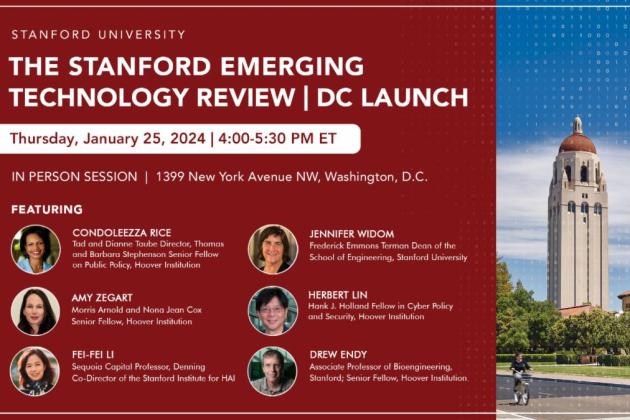
The Stanford Emerging Tech Review | DC Launch

The Hoover Institution and the School of Engineering at Stanford University invite you to the DC launch of the Stanford Emerging Technology Review at the Hoover DC office on Thursday, January 25th, from 4:00 PM - 5:30 PM ET.

January 25, 2024
Read More
Artificial Intelligence
News
Books
Stanford aims to help policy makers prepare for AI, robotics and more

A new project from Stanford University aims to help policymakers get their heads around a range of fast-developing new technologies, from AI and cryptography to robotics and synthetic biology.

December 11, 2023
Read More
Artificial Intelligence
News
Books
Stanford launches emerging-tech project co-led by Hoover Institution’s Condoleezza Rice

Former U.S. Secretary of State Condoleezza Rice is helping lead a new Stanford University initiative to provide “one-stop shopping” for government, businesses and the public to obtain timely information about new and evolving technologies.

December 08, 2023
Read More
Hoover research fellow Herbert Lin, the director and editor-in-chief of the Stanford Emerging Technology Review explains that advancements in a single field of emerging technology leads to advancements in others.
News
Books
Hoover Institution and School of Engineering launch emerging technology review

The Stanford Emerging Technology Review (SETR), a “one-stop-shopping primer” for policymakers on advancements in 10 key emerging technology areas, launched its first report in November.

December 08, 2023
Read More
SETR_SplashScreen_705px.jpg
News
Books
Introducing the Stanford Emerging Technology Review featuring Condoleezza Rice and Jennifer Widom

Introducing the Stanford Emerging Technology Review, an innovative project and publication dedicated to exploring the breakthroughs and policy implications of cutting-edge technologies that are shaping our societies and economies.In this video, the Review’s…

December 05, 2023 by Condoleezza Rice, Jennifer Widom
Read More
Solar
Article
Books
Yi Cui to lead Sustainability Accelerator; Roland Horne named interim Precourt Institute director

Cui has been leading both the Sustainability Accelerator and the Precourt Institute for Energy since April. With Horne transitioning to interim director of the Precourt Institute, Cui will continue engaging with the accelerator’s efforts to generate…

November 10, 2023 by Yi Cui
Read More
Science
Article
Books
Stanford professors promote bio-literacy through digital education

Drew Endy and Jenn Brophy take a step toward educating the world about bioengineering with a course offered to high school students nationwide.

September 27, 2023 by Drew Endy
Read More
AI Robot
Article
Books
Stanford AI professor Fei-Fei Li says we need more human-centered technology. Still, she had to convince herself to share her own story

A human story. Stanford professor Fei-Fei Li is an AI technologist known for her work to make the fast-moving technology more human, a crusade she launched via a widely-read 2018 New York Times op-ed. When she started to write a book, she focused on that work—…

November 15, 2023 by Fei-Fei Li
Read More
Robot
Article
Books
AI is at an inflection point, Fei-Fei Li says

The renowned AI researcher shares her thoughts on the hard problems that lie ahead for the field.

November 14, 2023 by Fei-Fei Li
Read More
Artificial Intelligence
Article
Books
Fei-Fei Li Started an AI Revolution by Seeing Like an Algorithm

Researcher Fei-Fei Li’s ImageNet project provided the feedstock for the deep learning boom that brought the world ChatGPT and other world-changing AI systems.

November 10, 2023 by Fei-Fei Li

You May Also Like

.
Director Rice, Senators Coons, and McCormick in conversation during their panel session.
The 2026 Stanford Emerging Technology Review Debuts In The Nation’s Capital
.
SETR 2026 Cover
2026 Edition Of The Stanford Emerging Technology Review Offers Policymakers And Business Leaders New Insights Into The Implications Of Frontier Technologies.
.
Drone
Technology Applications By Policy Area
.
Globe
Cross-Cutting Themes
.
Binary
Foreword
.
Stanford
Executive Summary
overlay image