






.
biotech
biotech
Biotechnology and Synthetic Biology
.
cryptography
crypto
Cryptography
.
materialscience
nano
Materials Science
.
neuroscience
neuroscience
Neuroscience
.
nuclear
nuclear
Nuclear Technologies
.
robotics
robotics
Robotics
.
semiconductor
semiconductors
Semiconductors
.
space
space
Space
.
Sustainable-Energy-Technologies_133px.jpg
energy
Sustainable Energy Technologies

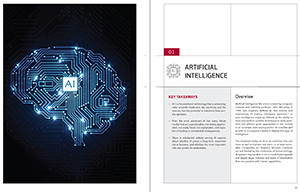
Key Takeaways

•   AI is a foundational technology that is advancing other scientific fields and, like electricity and the internet, has the potential to transform how society operates.

•   Even the most advanced AI has many failure modes that are unpredictable, not widely appreciated, not easily fixed, not explainable, and capable of leading to unintended consequences.

•   There is substantial debate among AI experts about whether AI poses a long-term existential risk to humans, and whether the most important risks are also current weaknesses of AI.

Icons_card_AI.png

Overview

Artificial intelligence (AI) is the ability of computers to perform functions associated with the human brain, including perceiving, reasoning, learning, interacting, problem solving, and exercising creativity. AI promises to be a fundamental enabler of technological advancement and progress in many fields, arguably as important as electricity or the internet.

SUBFIELDS

AI has three core subfields; the boundaries between them are often fluid.

  • Computer vision (CV) enables machines to recognize and understand visual information, convert pictures and videos into data, and make decisions based on the results.

  • Machine learning (ML) enables computers to perform tasks without explicit instructions, often by generalizing from patterns in data. ML includes deep learning that relies on multilayered artificial neural networks to model and understand complex relationships within data. 

  • Natural language processing (NLP) equips machines with capabilities to understand, interpret, and produce spoken words and written texts.
INPUTS TO MACHINE LEARNING
 

Most of today’s AI is based on machine learning (ML), though it draws on other subfields. ML requires data and computing power, often on an enormous scale. Data can take various forms, including text, images, videos, sensor readings, and more. The quality and quantity of data play a crucial role in determining the performance and capabilities of AI models. Without sufficient high-quality data, AI models may generate inaccurate or biased outcomes. Furthermore, the hardware costs of training leading AI models are substantial. For example, reports have estimated that the training of GPT-4, ChatGPT’s more capable cousin, costs at least a few hundred million dollars. Currently, only a select number of large US companies have the resources to build cutting-edge models from scratch. 

REGULATION
 

Research on foundational AI technologies is difficult—if not impossible—to regulate, especially when other nations have strong incentives to carry on regardless of actions taken by US policymakers. The same applies to voluntary restrictions on research by companies concerned about competition. Regulation of specific applications of AI may be more easily implemented, in part because of existing regulatory frameworks in application domains such as health care, finance, and law.
 

Over the Horizon

AI OPPORTUNITIES   
 

AI users will not be limited to those with specialized training; instead, the average person will interact directly with sophisticated AI applications for a multitude of everyday activities. While AI can automate a wide range of tasks, it has promise in enabling people to do what they are best at doing. AI systems can work alongside people, complementing and assisting rather than replacing them. Key sectors poised to take advantage of AI include health care, agriculture, law, and the logistics and transportation field.


AI RISKS    

The primary challenge of bringing AI innovation into operation is risk management. Some of the known issues with today’s leading AI models include:

  • Explainability: Today’s AI is for the most part incapable of explaining how it arrives at a specific conclusion. Explanations are not always necessary, but in cases such as medical decision making, they may be critical.

  • Bias and fairness: Machine learning models are trained on existing datasets, which means that any bias in the data can skew results. (For example, using historical employment information at a particular firm to predict which job applicants are most desirable may lead to hiring preferences for men.)

  • Vulnerability to spoofing: For many AI models, data inputs can be tweaked to fool them into drawing false conclusions.

  • Deepfakes: AI provides the capability for generating highly realistic but entirely inauthentic audio and video, with concerning implications for courtroom evidence and political deception.

  • Overtrust: As trust in AI grows, the risk of overlooking errors, mishaps, and unforeseen incidents also grows.
  • Hallucinations: AI models can generate results or answers that seem plausible but are completely made up, incorrect, or both.

Report Preview: Artificial Intelligence

Faculty Council Advisor

fei-fei-li_profilephoto.jpg
Fei-Fei Li
Author
Fei-Fei Li

Fei-Fei Li is the Sequoia Professor of Computer Science and professor, by courtesy, of psychology at Stanford University. She serves as codirector of Stanford’s Human-Centered AI Institute and as an affiliated faculty at Stanford Bio-X. Her current research includes cognitively inspired AI, machine learning, computer vision, and ambient intelligent systems for health-care delivery. She received her PhD in electrical engineering from the California Institute of Technology.

View Bio
fei-fei-li_profilephoto.jpg
Fei-Fei Li

Fei-Fei Li is the Sequoia Professor of Computer Science and professor, by courtesy, of psychology at Stanford University. She serves as codirector of Stanford’s Human-Centered AI Institute and as an affiliated faculty at Stanford Bio-X. Her current research includes cognitively inspired AI, machine learning, computer vision, and ambient intelligent systems for health-care delivery. She received her PhD in electrical engineering from the California Institute of Technology.

Access the 2023 Report

Read the complete report.

Access the 2025 Report

Read the complete report.

Explore

Date Range
CONTENT TYPE

Select Content Type

  • News
  • Article
  • Videos
  • Podcasts
  • Events
AUTHORS

Select Author

  • Condoleezza Rice
  • John Taylor
  • Jennifer Widom
  • Amy Zegart
  • Herbert Lin
  • Hon. Jerry McNerney
  • Hon. Robert Gates
  • Hon. Steven Chu
  • Hon. Susan M. Gordon
  • John Hennessy
  • Lloyd B. Minor
  • Mary Meeker
  • Peter Scher
  • Thomas M. Siebel
  • Zhenan Bao
  • Dan Boneh
  • Yi Cui
  • Simone D’Amico
  • Drew Endy
  • Siegfried Glenzer
  • Mark A. Horowitz
  • Fei-Fei Li
  • Allison Okamura
  • Kang Shen
  • Eric Schmidt
  • Steven Koonin
  • Sally Benson
  • Norbert Holtkamp
  • Martin Giles
  • Jon Simon
FOCUS AREAS

Artificial Intelligence

  • Artificial Intelligence
  • Biotechnology and Synthetic Biology
  • Sustainable Energy Technologies
  • Cryptography
  • Materials Science
  • Neuroscience
  • Nuclear Technologies
  • Robotics
  • Semiconductors
  • Space
  • Technology Test Page
  • Lasers
  • Artificial Intelligence
  • Biotechnology and Synthetic Biology
  • Cryptography
  • Materials Science
  • Neuroscience
  • Robotics
  • Semiconductors
  • Sustainable Energy Technologies
  • Space
  • Artificial Intelligence
  • Biotechnology and Synthetic Biology
  • Cryptography and Computer Security
  • Materials Science
  • Neuroscience
  • Robotics
  • Semiconductors
  • Space
  • Energy Technologies
  • Quantum Technologies
Date (field_date)
Read More
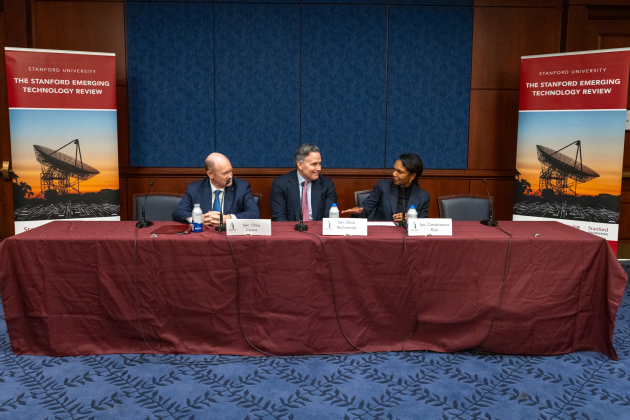
Director Rice, Senators Coons, and McCormick in conversation during their panel session.
News
Books
The 2026 Stanford Emerging Technology Review Debuts In The Nation’s Capital

Senators Chris Coons (D-DE) and Dave McCormick (R-PA) joined Hoover Institution Director Condoleezza Rice, Stanford School of Engineering Dean Jennifer Widom, Senior Fellow Amy Zegart, and contributing scholars at an event in the US Capitol on January 28 to…

February 04, 2026
Read More
SETR 2026 Cover
News
Books
2026 Edition Of The Stanford Emerging Technology Review Offers Policymakers And Business Leaders New Insights Into The Implications Of Frontier Technologies.

The 2025 edition of the Stanford Emerging Technology Review (SETR) report is now available, offering American policymakers a comprehensive overview of how ten frontier technologies, from artificial intelligence to robotics, are transforming the world.

January 26, 2025
Read More
Drone
Article
Books
Technology Applications By Policy Area

This chapter explores applications from each of the ten technology fields described in the report as they may relate to five important policy themes: economic growth, national security, environmental and energy sustainability, health and medicine, and civil…

February 07, 2025
Read More
Globe
Article
Books
Cross-Cutting Themes

One of the most important and unusual hallmarks of this moment is convergence: emerging technologies are intersecting and interacting in a host of ways, with important implications for policy. This chapter identifies themes and commonalities that cut across…

February 07, 2025
Read More
Binary
Article
Books
Foreword

Emerging technologies are transforming societies, economies, and geopolitics. Never have we experienced the convergence of so many technologies with the potential to change so much, so fast, and at such high stakes. This report is intended to help readers…

Read More
Stanford
Article
Books
Executive Summary

This report offers an easy-to-use reference tool that harnesses the expertise of Stanford University’s leading science and engineering faculty in ten major technological areas: artificial intelligence, biotechnology and synthetic biology, cryptography and…

January 26, 2026
Read More
SETR_booklet_2026_cover.jpg
Events
Books
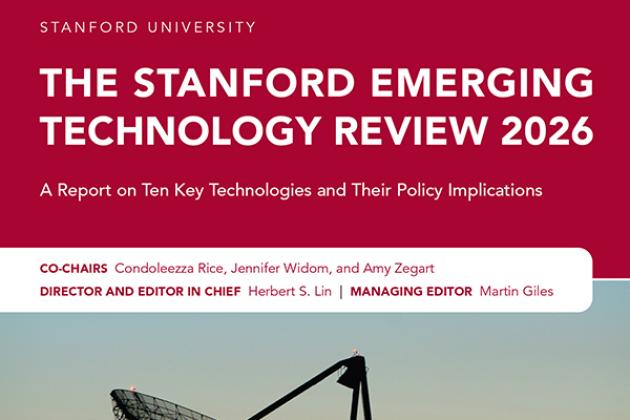
The Stanford Emerging Technology Review 2026

The Hoover Institution and the School of Engineering at Stanford University invite you to the DC launch of the 2026 Stanford Emerging Technology Review on Wednesday, January 28th, from 4:00 PM - 7:00 PM ET.

January 28, 2026
Read More
Lasers
Article
Books
Lasers: Useful and Ubiquitous

In peace and war, the technology continually finds new applications.

August 27, 2025
Read More
SETR Lasers Video
News
Books
The Future of Laser Technology

From eye surgery to missile defense, lasers have become an invaluable technology reshaping medicine, communications, manufacturing, and national security. Sound policy is needed to balance innovation, dual-use risks, and U.S. competitiveness in the laser age.

August 27, 2025 by Siegfried Glenzer
Read More
The Future of Robotics
News
Books
The Future of Robotics

From autonomous machines in construction to wearable robotics in eldercare, robotics is transforming the physical economy, reshaping the future of work, defense, and human-machine interaction. Strategic leadership is needed to harness robotics innovation,…

August 05, 2025 by Allison Okamura

You May Also Like

.
technologyabstract
The Care and Feeding of Transformative Tech
.
artificial intelligence istock
Artificial Intelligence: Supercharging Science
.
SETR AI Video
The Future of Artificial Intelligence
.
Drone
Technology Applications By Policy Area
.
Globe
Cross-Cutting Themes
.
Binary
Foreword
.
Artificial Intelligence
US Wants Cloud Firms to Report Foreign Users Building AI
.
artificial intelligence
Raimondo considers cloud reporting rules for foreign AI developers
.
artificial intelligence
OpenAI and Other Tech Giants Will Have to Warn the US Government When They Start New AI Projects
.
technologyiStock-1328282379
Commerce Secretary and Others on AI and Innovation
.
Artificial Intelligence
Stanford aims to help policy makers prepare for AI, robotics and more
.
Artificial Intelligence
Stanford launches emerging-tech project co-led by Hoover Institution’s Condoleezza Rice
.
Hoover research fellow Herbert Lin, the director and editor-in-chief of the Stanford Emerging Technology Review explains that advancements in a single field of emerging technology leads to advancements in others.
Hoover Institution and School of Engineering launch emerging technology review
.
AI Robot
Stanford AI professor Fei-Fei Li says we need more human-centered technology. Still, she had to convince herself to share her own story
.
Robot
AI is at an inflection point, Fei-Fei Li says
.
Artificial Intelligence
Fei-Fei Li Started an AI Revolution by Seeing Like an Algorithm
.
Artificial intelligence
Trailblazing computer scientist Fei-Fei Li on human-centered AI
.
Drone
Technology Applications By Policy Area
.
Globe
Cross-Cutting Themes
.
Stanford
Executive Summary
.
Binary
Foreword
overlay image