








.
AI_133px.jpg
ai
Artificial Intelligence
.
biotech
biotech
Biotechnology and Synthetic Biology
.
cryptography
crypto
Cryptography
.
Lasers
Lasers
Lasers
.
neuroscience
neuroscience
Neuroscience
.
robotics
robotics
Robotics
.
semiconductor
semiconductors
Semiconductors
.
space
space
Space
.
Sustainable-Energy-Technologies_133px.jpg
energy
Sustainable Energy Technologies

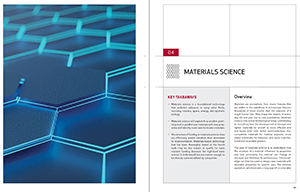
KEY TAKEAWAYS

•  Materials science is a foundational technology that underlies advances in many other
fields, including robotics, space, energy, and synthetic biology.

•  Materials science will exploit artificial intelligence as another promising tool to predict new materials with new properties and identify novel uses for known materials.

•  Future progress in materials science requires new funding mechanisms to more effectively transition from innovation to implementation and access to more computational power.

Icons_card_Nano.png

Overview

From semiconductors in computer chips to plastics in everyday objects, materials are everywhere. Knowing how to synthesize and process them, as well as understanding their structure and properties, has helped to shape the world around us. Materials science contributes to the development of stronger, lighter materials that improve everything from battery electrodes to medical implants and from automobiles to spacecraft.

Broadly speaking, materials science and engineering research focuses on four major activities. The first is the study of the structure of materials to understand how they are composed and organized from atomic to macroscopic scales. The second involves verifying the properties of materials, such as their conductivity, strength, and elasticity. The third area covers analysis and benchmarking of how materials perform in specific situations. The final one involves assessing how materials can be fabricated and manufactured.


KEY DEVELOPMENTS

  • Flexible electronics involves the creation of electrical devices that can bend, stretch, and deform without compromising their performance. These can be used as wearable, skin-like devices. For instance, a “smart bandage” with integrated sensors to monitor wound conditions and provide electrical stimulation can cut the time needed to heal chronic wounds by 25 percent.
  • Additive manufacturing, colloquially known as 3-D printing, is one of the most promising advances in materials processing over the past fifteen years. The technology comes in different forms. For instance, a method known as continuous liquid interface production (CLIP) uses directed ultraviolet light to form structures from a polymer resin.
  • Nanotechnology exploits the properties of nanoscale materials (i.e., with one or more dimensions of 1–100 nanometers) that differ from the same materials in bulk—including electronic, optical, magnetic, thermal, and mechanical properties.
  • Quantum dots are spherical nanocrystals that emit light and are used in television displays. They are a model example of a material whose properties vary because of its scale—in dot form, their optoelectronic properties differ from those of the same material when found in bulk. They can be used in areas such as medical imaging, solar cells, chemical and biological detection sensors, and anticounterfeiting measures.

The fundamental challenge of materials science as a discipline is the vast number of possible materials and material combinations that are possible and the associated time and cost involved in their synthesis and characterization (which is the general process by which materials’ structure and properties are ascertained through spectroscopic, microscopic, and several other complementary methods). 

Artificial intelligence (AI)—and, in particular, machine learning (ML)—offers promising solutions by leveraging experimental and computational data on the properties of materials. ML algorithms can recognize patterns in existing data and make generalized predictions about new materials. Their results provide a starting point for further exploration, but additional laboratory-derived data is needed to make ML-informed solutions more accurate, especially in the case of complex materials. 

Another application of ML in materials science involves examining scientific literature for hidden relationships that could reveal latent knowledge about materials and point to new research directions. This approach has also been used to improve the design of electrolytes used in batteries and has been deployed in automated labs that can rapidly synthesize and characterize materials at scale.
 

Over the Horizon

The materials research infrastructure today does not adequately support the transition from research to real-word applications at scale. Such transitions generally require launching a small-scale pilot project to demonstrate the feasibility of potential largescale manufacturing. The reason pilots are necessary is that when the technology emerges from basic research, it is by definition too mature to qualify for research funding that is directed toward fundamental understanding but not mature enough to be commercialized by actual companies. However, neither government nor venture capital investors are particularly enthusiastic about financing pilot projects.

New funding vehicles are therefore needed to bridge this gap between bench-scale research and company-level investment. Such support could also establish national rapid prototyping centers, where academic researchers can find the help and tools necessary to build prototypes and pilot plants for their technology.

There is hope that ML-guided approaches will dramatically shorten the timescale for materials discovery and enable the design of materials optimized for specific applications. Continued development of both bottom-up computational approaches and top-down experimental data‒driven methods will be needed to bridge the gap between fundamental material parameters and real-world device performance.

POLICY, LEGAL & REGULATORY ISSUES

  • Toxicity and environmental issues: As with regulation in other areas of technology, materials science faces concerns about balancing the need to ensure public safety with the imperative to innovate quickly. Nanoparticles raise particular concern because their small size may enable them to pass through various biological borders such as cell membranes. Multiple US government agencies currently oversee the regulation of and infrastructure for nanomaterials research.
  • Foreign collaboration and competition: Historically, the US has led the world in nanotechnology, but the gap between it and China has narrowed. As great-power competition intensifies, many researchers are concerned that fundamental research could now be subject to export controls, deterring international collaborations. There is an urgent need for clarification of these policies, particularly those delineating fundamental research and export-controlled research. 
  • Infrastructure for ML-assisted materials science: The United States benefits from having some of the world’s largest supercomputing resources, which are essential not only for ML but for developing extensive databases. However, better access to computing power—and to data—is needed to generate and analyze data effectively.

Report Preview: Materials Science

Faculty Council Advisor

zhenan-bao_profilephoto.jpg
Zhenan Bao
Author
Zhenan Bao

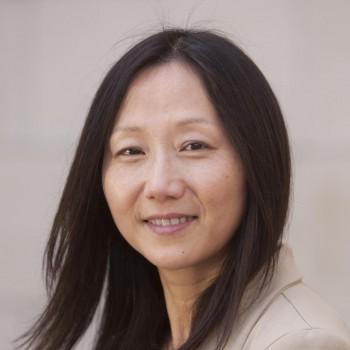
Zhenan Bao is the K. K. Lee Professor in Chemical Engineering and Professor, by courtesy, of chemistry and materials science and engineering at Stanford University. She has close to seven hundred referred publications and more than eighty US patents. Her current research focuses on organic electronics, including skin-inspired materials, dynamic energy storage, and recyclable, re-processable materials. She received her PhD in chemistry from the University of Chicago.

View Bio
zhenan-bao_profilephoto.jpg
Zhenan Bao

Zhenan Bao is the K. K. Lee Professor in Chemical Engineering and Professor, by courtesy, of chemistry and materials science and engineering at Stanford University. She has close to seven hundred referred publications and more than eighty US patents. Her current research focuses on organic electronics, including skin-inspired materials, dynamic energy storage, and recyclable, re-processable materials. She received her PhD in chemistry from the University of Chicago.

Access the Complete Report

Read the complete report.

Explore

Date Range
CONTENT TYPE

Select Content Type

  • News
  • Article
  • Videos
  • Podcasts
  • Events
AUTHORS

Select Author

  • Condoleezza Rice
  • John Taylor
  • Jennifer Widom
  • Amy Zegart
  • Herbert Lin
  • Hon. Jerry McNerney
  • Hon. Robert Gates
  • Hon. Steven Chu
  • Hon. Susan M. Gordon
  • John Hennessy
  • Lloyd B. Minor
  • Mary Meeker
  • Peter Scher
  • Thomas M. Siebel
  • Zhenan Bao
  • Dan Boneh
  • Yi Cui
  • Simone D’Amico
  • Drew Endy
  • Siegfried Glenzer
  • Mark A. Horowitz
  • Fei-Fei Li
  • Allison Okamura
  • Kang Shen
  • Eric Schmidt
  • Steven Koonin
  • Sally Benson
  • Norbert Holtkamp
  • Martin Giles
  • Jon Simon
FOCUS AREAS

Materials Science

  • Artificial Intelligence
  • Biotechnology and Synthetic Biology
  • Sustainable Energy Technologies
  • Cryptography
  • Materials Science
  • Neuroscience
  • Nuclear Technologies
  • Robotics
  • Semiconductors
  • Space
  • Technology Test Page
  • Lasers
  • Artificial Intelligence
  • Biotechnology and Synthetic Biology
  • Cryptography
  • Materials Science
  • Neuroscience
  • Robotics
  • Semiconductors
  • Sustainable Energy Technologies
  • Space
  • Artificial Intelligence
  • Biotechnology and Synthetic Biology
  • Cryptography and Computer Security
  • Materials Science
  • Neuroscience
  • Robotics
  • Semiconductors
  • Space
  • Energy Technologies
  • Quantum Technologies
Date (field_date)
Read More
test
Events
Books
The Stanford Emerging Tech Review | DC Launch

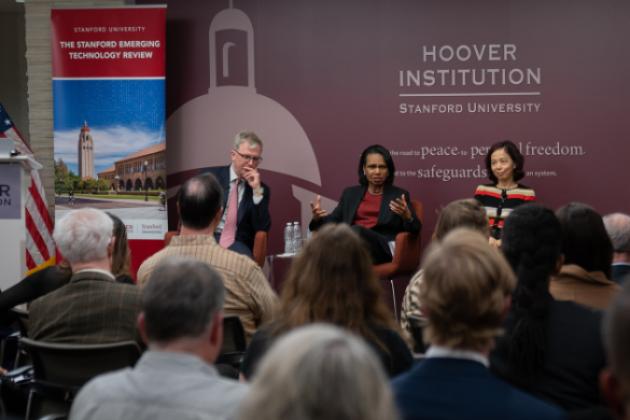
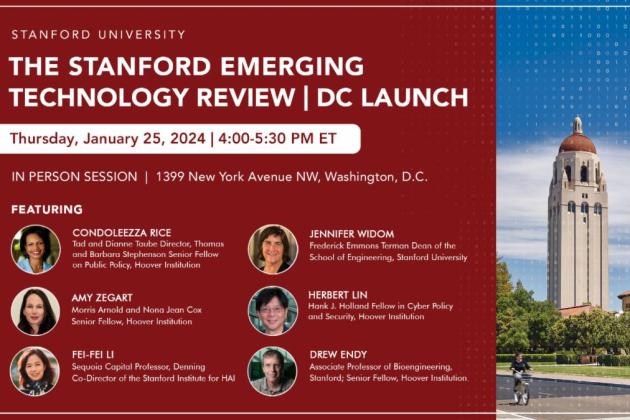
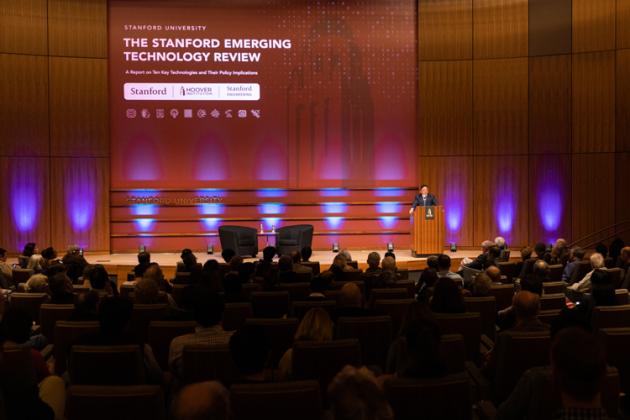
The Hoover Institution and the School of Engineering at Stanford University invite you to the DC launch of the Stanford Emerging Technology Review at the Hoover DC office on Thursday, January 25th, from 4:00 PM - 5:30 PM ET.

January 25, 2024
Read More
Artificial Intelligence
News
Books
Stanford aims to help policy makers prepare for AI, robotics and more

A new project from Stanford University aims to help policymakers get their heads around a range of fast-developing new technologies, from AI and cryptography to robotics and synthetic biology.

December 11, 2023
Read More
Artificial Intelligence
News
Books
Stanford launches emerging-tech project co-led by Hoover Institution’s Condoleezza Rice

Former U.S. Secretary of State Condoleezza Rice is helping lead a new Stanford University initiative to provide “one-stop shopping” for government, businesses and the public to obtain timely information about new and evolving technologies.

December 08, 2023
Read More
Hoover research fellow Herbert Lin, the director and editor-in-chief of the Stanford Emerging Technology Review explains that advancements in a single field of emerging technology leads to advancements in others.
News
Books
Hoover Institution and School of Engineering launch emerging technology review

The Stanford Emerging Technology Review (SETR), a “one-stop-shopping primer” for policymakers on advancements in 10 key emerging technology areas, launched its first report in November.

December 08, 2023
Read More
SETR_SplashScreen_705px.jpg
News
Books
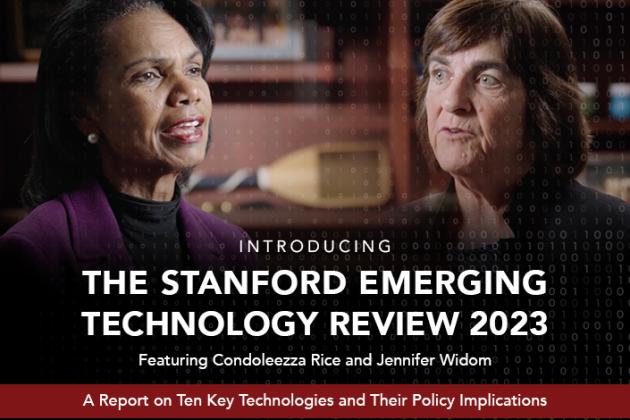
Introducing the Stanford Emerging Technology Review featuring Condoleezza Rice and Jennifer Widom

Introducing the Stanford Emerging Technology Review, an innovative project and publication dedicated to exploring the breakthroughs and policy implications of cutting-edge technologies that are shaping our societies and economies.In this video, the Review’s…

December 05, 2023 by Condoleezza Rice, Jennifer Widom
Read More
Solar
Article
Books
Yi Cui to lead Sustainability Accelerator; Roland Horne named interim Precourt Institute director

Cui has been leading both the Sustainability Accelerator and the Precourt Institute for Energy since April. With Horne transitioning to interim director of the Precourt Institute, Cui will continue engaging with the accelerator’s efforts to generate…

November 10, 2023 by Yi Cui
Read More
Science
Article
Books
Stanford professors promote bio-literacy through digital education

Drew Endy and Jenn Brophy take a step toward educating the world about bioengineering with a course offered to high school students nationwide.

September 27, 2023 by Drew Endy
Read More
AI Robot
Article
Books
Stanford AI professor Fei-Fei Li says we need more human-centered technology. Still, she had to convince herself to share her own story

A human story. Stanford professor Fei-Fei Li is an AI technologist known for her work to make the fast-moving technology more human, a crusade she launched via a widely-read 2018 New York Times op-ed. When she started to write a book, she focused on that work—…

November 15, 2023 by Fei-Fei Li
Read More
Robot
Article
Books
AI is at an inflection point, Fei-Fei Li says

The renowned AI researcher shares her thoughts on the hard problems that lie ahead for the field.

November 14, 2023 by Fei-Fei Li
Read More
Artificial Intelligence
Article
Books
Fei-Fei Li Started an AI Revolution by Seeing Like an Algorithm

Researcher Fei-Fei Li’s ImageNet project provided the feedstock for the deep learning boom that brought the world ChatGPT and other world-changing AI systems.

November 10, 2023 by Fei-Fei Li

You May Also Like

.
SETR_booklet_2026_cover.jpg
The Stanford Emerging Technology Review 2026
.
Interplay of digital circuit and number graphics on the subject of electronics, computers, communications and modern technologies.
How Emerging Technologies Take Shape
.
technologyabstract
The Care and Feeding of Transformative Tech
.
Stanford and Hoover Institution contributors to the Stanford Emerging Technology Review are seen on Capitol Hill on February 25, 2025. (DMV Productions)
Stanford Emerging Technology Review Highlights Promise and Risk of Frontier Tech to Washington, DC Policymakers
.
SETR 2025 Cover
Stanford Emerging Technology Review Offers Policymakers New Insights
.
The Interconnect Logo
CFR and the Stanford Emerging Technology Review Launch New Podcast Series on Frontier Technologies
.
SETR in DC | Feb. 25, 2025
The Stanford Emerging Technology Review 2025: Frontier Tech For A New Geopolitical Era
.
Bio-Strategies and Leadership Holds Inaugural Congressional Fellowship Program on Biotechnology Strategy
.
Tech Track II 2024
Government Officials, Hoover Fellows, and Silicon Valley Leaders Discuss Cooperation at Sixth Annual Tech Track II Symposium
.
Stanford
Executive Summary
overlay image