









.
AI_133px.jpg
ai
Artificial Intelligence
.
biotech
biotech
Biotechnology and Synthetic Biology
.
cryptography
crypto
Cryptography
.
Lasers
Lasers
Lasers
.
materialscience
nano
Materials Science
.
neuroscience
neuroscience
Neuroscience
.
robotics
robotics
Robotics
.
semiconductor
semiconductors
Semiconductors
.
space
space
Space

KEY TAKEAWAYS

•   Although many clean energy technologies are now available and increasingly affordable, scaling them to a meaningful degree and building the massive infrastructure needed to deploy them will take decades.

•   The largest impact on reducing emissions in the near to medium term will come from building a no- to very-low-emission electricity grid, electrifying passenger cars and small commercial vehicles, and transitioning residential and commercial heating and industrial energy.

•   In the long term, technologies for decarbonizing buses and long-haul trucks, decarbonizing carbon-intensive industries, and reducing greenhouse gases from refrigerants and agriculture will play key roles in a net-zero, emissions-free energy infrastructure.

Icons_card_Energy.png

Overview

The transition to sustainable energy relies on improving every step of the energy supply chain, from generation to transmission to storage. However, the sheer scale of global energy has two major implications. First, no single technology or breakthrough can meet the world’s demands for energy. Success will require a combination of approaches that bridge present sources, consumption, and infrastructure to a more sustainable future. Second, the imperative to deliver energy at scale unavoidably places an emphasis on cost. High-cost technologies, whether old or new and no matter how promising, cannot be deployed on a wide scale.


KEY DEVELOPMENTS

Substantial progress has been made in several sustainable energy technologies, including wind and solar generation of electricity; lower-loss long-distance transmission; lithium-ion (Li-ion) batteries for storing excess renewable energy produced when demand is low and for use in electric vehicles (EVs); efficient lightemitting diode (LED) lighting; and heat pumps for heating and cooling. But the widespread deployment of such technologies requires overcoming a variety of challenges, including a lack of sufficient public charging infrastructure for EVs, constraints in the raw materials supply chain to manufacture some of these technologies, and high up-front costs.

The technical feasibility of nuclear fission for generating electricity is well established. But many concerns related to economics and public acceptability remain to be overcome before the widespread deployment of fission reactors is possible. These include a legacy of significant cost overruns and construction delays; fuel security; manufacturing capability to build the hundreds of reactors that will be needed to meet the US goal of tripling nuclear-generated electricity by 2050; reactor safety; waste management; and nuclear weapons proliferation that might be prompted by widespread reactor deployments.

Over the Horizon

Several important technologies await future refinement before they can be used
on a large scale.

Energy Storage and Batteries 

Energy storage is a core area of effort to make the energy grid more sustainable. Batteries have been the traditional way to capture and release electrical energy but are not yet sufficiently cost-effective for grid-scale storage. Long-duration energy-storage technologies like gravity, thermal, and mechanical storage aim to store energy without batteries, but scaling them remains a hurdle.

Batteries for long-duration energy storage need to be able to endure tens of thousands of capture-and-release cycles, retain charge over several hundreds of hours, and be made of inexpensive materials. Aqueous battery chemistries such as manganese-hydrogen batteries are more promising than Li-ion batteries from a cost perspective.

Renewable Fuels

Beyond storage, efforts are under way to deploy combustible fuels such as biodiesel and hydrogen that can be burned on demand but that are cleaner than traditional fossil fuels. Hydrogen, in particular, has been identified as a promising zero-carbon-emissions fuel source since its energy density by weight is three times that of fossil fuels. However, even in liquid or compressed-gas form (necessary for most transportation applications), hydrogen has a low energy density by volume— which means that a hydrogen fuel tank of a given size can carry much less energy than a gasoline fuel tank.

Finding cost-effective ways to produce hydrogen and carry it with acceptable leakage from production facilities to users is an additional challenge. Currently, it is sourced from fossil fuels through processes such as naphtha reforming, natural gas steam reforming, and coal gasification. Known as gray hydrogen, this conventional hydrogen has a significant carbon footprint and is not sustainable. Blue hydrogen, which is created from methane, and green hydrogen, which uses renewable electricity to generate hydrogen from water, are gaining attention because neither process emits greenhouse gases.

Carbon Capture and Removal

Carbon capture technologies work by capturing “new” carbon emissions produced by industrial processes or the burning of fossil fuels and then burying them, thereby preventing them from entering the atmosphere. Carbon removal refers to capturing “old,” or existing, carbon from the atmosphere. Both capture and removal are gaining research attention and could help users obtain some of the benefits of fossil fuels while minimizing carbon emissions.

Fusion

Fusion power continues to hold promise as a potentially limitless and inherently safe source of energy, but significant scientific and engineering breakthroughs are still needed to make it commercially viable. Commercial-scale fusion power plants are unlikely to play any important short-term role in reducing greenhouse gas emissions.

Grid Technologies

The future electric grid will be more extensive and complex than today’s version, with distributed power generation, consumption, and storage. Power sources will be largely decentralized. As electrical demand rises, grid capacity must expand significantly, potentially doubling or tripling in size and necessitating substantial infrastructure upgrades to manage larger and more variable energy flows. The future development of a “smart grid,” whose goal is to enhance efficiency, reliability, and resilience, will involve initiatives to replace old transmission lines with higher-performing ones, create vehicle-to-grid (V2G) systems that allow unused power from vehicle batteries to be fed to the grid, and deploy AI-driven energy systems to optimize grid operations and predict equipment failures.

POLICY, LEGAL & REGULATORY ISSUES

The most important policy issue related to sustainable energy is the need for a national consensus for continued support over the long term. For the next generation of emission-free technologies, America must sustain a stable innovation ecosystem over several decades.

A second major issue is the capability for manufacturing at scale—a capability the United States has largely lost. Because a meaningful energy transition depends on deployments at scale, promoting domestic production will be vitally important.

Third, policy must account for the harmful waste that even sustainable energy projects produce. Many forms of sustainable energy also require new acquisitions of land to build generating stations and storage facilities. Addressing these concerns proactively can minimize negative environmental impacts.

REPORT PREVIEW: Sustainable Energy Technologies

Faculty Council Advisor

yi-cui_profilephoto.jpg
Yi Cui
Author
Yi Cui

Yi Cui is the director of the Precourt Institute for Energy, the Fortinet Founders Professor of materials science and engineering, and professor of energy science and engineering and, by courtesy, of chemistry at Stanford University. He is also a senior fellow at the Stanford Woods Institute for the Environment and codirector of Stanford StorageX Initiative. His research focuses on nanomaterials, nanobiotechnology, and nanoenvironmental technologies. He received his PhD in chemistry from Harvard University.

View Bio
yi-cui_profilephoto.jpg
Yi Cui

Yi Cui is the director of the Precourt Institute for Energy, the Fortinet Founders Professor of materials science and engineering, and professor of energy science and engineering and, by courtesy, of chemistry at Stanford University. He is also a senior fellow at the Stanford Woods Institute for the Environment and codirector of Stanford StorageX Initiative. His research focuses on nanomaterials, nanobiotechnology, and nanoenvironmental technologies. He received his PhD in chemistry from Harvard University.

Access the Complete Report

Read the complete report.

Explore

Date Range
CONTENT TYPE

Select Content Type

  • News
  • Article
  • Videos
  • Podcasts
  • Events
AUTHORS

Select Author

  • Condoleezza Rice
  • John Taylor
  • Jennifer Widom
  • Amy Zegart
  • Herbert Lin
  • Hon. Jerry McNerney
  • Hon. Robert Gates
  • Hon. Steven Chu
  • Hon. Susan M. Gordon
  • John Hennessy
  • Lloyd B. Minor
  • Mary Meeker
  • Peter Scher
  • Thomas M. Siebel
  • Zhenan Bao
  • Dan Boneh
  • Yi Cui
  • Simone D’Amico
  • Drew Endy
  • Siegfried Glenzer
  • Mark A. Horowitz
  • Fei-Fei Li
  • Allison Okamura
  • Kang Shen
  • Eric Schmidt
  • Steven Koonin
  • Sally Benson
  • Norbert Holtkamp
  • Martin Giles
  • Jon Simon
FOCUS AREAS

Sustainable Energy Technologies

  • Artificial Intelligence
  • Biotechnology and Synthetic Biology
  • Sustainable Energy Technologies
  • Cryptography
  • Materials Science
  • Neuroscience
  • Nuclear Technologies
  • Robotics
  • Semiconductors
  • Space
  • Technology Test Page
  • Lasers
  • Artificial Intelligence
  • Biotechnology and Synthetic Biology
  • Cryptography
  • Materials Science
  • Neuroscience
  • Robotics
  • Semiconductors
  • Sustainable Energy Technologies
  • Space
  • Artificial Intelligence
  • Biotechnology and Synthetic Biology
  • Cryptography and Computer Security
  • Materials Science
  • Neuroscience
  • Robotics
  • Semiconductors
  • Space
  • Energy Technologies
  • Quantum Technologies
Date (field_date)
Read More
Director Rice, Senators Coons, and McCormick in conversation during their panel session.
News
Books
The 2026 Stanford Emerging Technology Review Debuts In The Nation’s Capital

Senators Chris Coons (D-DE) and Dave McCormick (R-PA) joined Hoover Institution Director Condoleezza Rice, Stanford School of Engineering Dean Jennifer Widom, Senior Fellow Amy Zegart, and contributing scholars at an event in the US Capitol on January 28 to…

February 04, 2026
Read More
SETR 2026 Cover
News
Books
2026 Edition Of The Stanford Emerging Technology Review Offers Policymakers And Business Leaders New Insights Into The Implications Of Frontier Technologies.

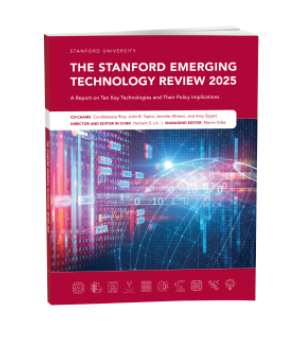
The 2025 edition of the Stanford Emerging Technology Review (SETR) report is now available, offering American policymakers a comprehensive overview of how ten frontier technologies, from artificial intelligence to robotics, are transforming the world.

January 26, 2025
Read More
Drone
Article
Books
Technology Applications By Policy Area

This chapter explores applications from each of the ten technology fields described in the report as they may relate to five important policy themes: economic growth, national security, environmental and energy sustainability, health and medicine, and civil…

February 07, 2025
Read More
Globe
Article
Books
Cross-Cutting Themes

One of the most important and unusual hallmarks of this moment is convergence: emerging technologies are intersecting and interacting in a host of ways, with important implications for policy. This chapter identifies themes and commonalities that cut across…

February 07, 2025
Read More
Binary
Article
Books
Foreword

Emerging technologies are transforming societies, economies, and geopolitics. Never have we experienced the convergence of so many technologies with the potential to change so much, so fast, and at such high stakes. This report is intended to help readers…

Read More
Stanford
Article
Books
Executive Summary

This report offers an easy-to-use reference tool that harnesses the expertise of Stanford University’s leading science and engineering faculty in ten major technological areas: artificial intelligence, biotechnology and synthetic biology, cryptography and…

January 26, 2026
Read More
SETR_booklet_2026_cover.jpg
Events
Books
The Stanford Emerging Technology Review 2026

The Hoover Institution and the School of Engineering at Stanford University invite you to the DC launch of the 2026 Stanford Emerging Technology Review on Wednesday, January 28th, from 4:00 PM - 7:00 PM ET.

January 28, 2026
Read More
Lasers
Article
Books
Lasers: Useful and Ubiquitous

In peace and war, the technology continually finds new applications.

August 27, 2025
Read More
SETR Lasers Video
News
Books
The Future of Laser Technology

From eye surgery to missile defense, lasers have become an invaluable technology reshaping medicine, communications, manufacturing, and national security. Sound policy is needed to balance innovation, dual-use risks, and U.S. competitiveness in the laser age.

August 27, 2025 by Siegfried Glenzer
Read More
The Future of Robotics
News
Books
The Future of Robotics

From autonomous machines in construction to wearable robotics in eldercare, robotics is transforming the physical economy, reshaping the future of work, defense, and human-machine interaction. Strategic leadership is needed to harness robotics innovation,…

August 05, 2025 by Allison Okamura

You May Also Like

.
SETR_booklet_2026_cover.jpg
The Stanford Emerging Technology Review 2026
.
Interplay of digital circuit and number graphics on the subject of electronics, computers, communications and modern technologies.
How Emerging Technologies Take Shape
.
technologyabstract
The Care and Feeding of Transformative Tech
.
Stanford and Hoover Institution contributors to the Stanford Emerging Technology Review are seen on Capitol Hill on February 25, 2025. (DMV Productions)
Stanford Emerging Technology Review Highlights Promise and Risk of Frontier Tech to Washington, DC Policymakers
.
SETR 2025 Cover
Stanford Emerging Technology Review Offers Policymakers New Insights
.
The Interconnect Logo
CFR and the Stanford Emerging Technology Review Launch New Podcast Series on Frontier Technologies
.
SETR in DC | Feb. 25, 2025
The Stanford Emerging Technology Review 2025: Frontier Tech For A New Geopolitical Era
.
Bio-Strategies and Leadership Holds Inaugural Congressional Fellowship Program on Biotechnology Strategy
.
Tech Track II 2024
Government Officials, Hoover Fellows, and Silicon Valley Leaders Discuss Cooperation at Sixth Annual Tech Track II Symposium
.
Stanford
Executive Summary
overlay image