





.
AI_133px.jpg
ai
Artificial Intelligence
.
cryptography
crypto
Cryptography and Computer Security
.
Sustainable-Energy-Technologies_133px.jpg
energy
Energy Technologies
.
materialscience
nano
Materials Science
.
neuroscience
neuroscience
Neuroscience
.
Quantum Technologies
.
robotics
robotics
Robotics
.
semiconductor
semiconductors
Semiconductors
.
space
space
Space

KEY TAKEAWAYS

•   Biotechnology is emerging as a general-purpose technology by which anything bioengineers learn to encode in DNA can be grown whenever and wherever needed— essentially enabling the production of a wide range of products through biological processes across multiple sectors.

•   The United States is still not executing well on strategies for emerging biotechnology and has relied too heavily on private-sector investment to support foundational work needed to scale and sustain progress.

•   Biotechnology is one of the most important areas of technological competition between the United States and China, and China is now leveraging two decades of strategic investment to secure global leadership. Absent swift and ambitious actions, the United States risks biotechnological surprise and a loss of biotechnology sovereignty.

Icons_card_Biotech.png

Overview

Biotechnology partners with biology to create products and services, such as engineering skin microbes to fight cancer or brewing medicines from yeast. This industry, already 5 percent of US GDP, is poised for significant growth. Synthetic biology, a subset of biotechnology focusing on enhancing living systems, relies on DNA sequencing and synthesis. DNA sequencers are machines that read or decode specific DNA molecules, while synthesizers write user-specified sequences of DNA. Rapid progress in these technologies is driving innovation and expanding biotechnology’s potential applications. 

Biology as a manufacturing process is distributed—leaves do not come from a central production facility but rather grow on trees everywhere. However, commercial biotechnology has become centralized and capital intensive. This contrast suggests a potential paradigm shift toward a more distributed approach in biotechnology, aligning it more closely with nature’s decentralized production model. 

Synthetic biology merges biology, engineering, and computer science to modify and create living systems, developing novel biological functions served by amino acids, proteins, and cells not found in nature. This field creates reusable biological “parts,” streamlining design processes and reducing the need to start from scratch, thus advancing biotechnology’s capabilities and efficiency. 

Synthetic biology has applications in medicine, agriculture, manufacturing, and sustainability. DNA and RNA synthesis underlies all mRNA vaccines, including those for COVID-19. Synthetic biology can also cultivate drought-resistant crops and enable the programming of cells to manufacture medicines or fuel on an agile, distributed basis.


Key Developments 

Distributed Biomanufacturing This offers unprecedented production flexibility in both location and timing. Fermentation production sites can be established anywhere with access to sugar and electricity. The approach enables swift responses to sudden demands like disease outbreaks requiring specific medications. Such adaptability revolutionizes manufacturing, making it more efficient and responsive to urgent needs.

Biological Computing Computing has become central to modern biology. For example, artificial intelligence (AI) methods accelerate research by enabling the computational exploration of protein behavior, significantly reducing (though not eliminating) the need for expensive laboratory experiments. Large language models (LLMs), a form of AI, are being trained on natural DNA, RNA, and protein sequences. Called BioLLMs, they can generate new biologically significant sequences that are helpful points of departure for designing useful proteins. Models and software can be used to generate promising drug designs that may be able to speed up drug discovery from months or years to weeks.
 

Over the Horizon

Routinization of Cellular-Scale Engineering Today, most of biotechnology operates through trial-and-error “design-build-test-learn” cycles that rely on expert labor and extensive experimentation. A transformative alternative is emerging that involves constructing cells entirely from defined chemical components. Progress in synthetic cell creation promises systems capable of autonomous growth and evolution, enabling routine, analysis-driven engineering—or “design-buildwork”— at the cellular level. Achieving this routinization would mark a Sputnik-like moment for biotechnology, freeing bioengineering from natural constraints and enabling scalable, reliable design of new biological systems unconstrained by Earth’s evolutionary lineages. 

Electrobiosynthesis Photosynthesis is a natural process that captures atmospheric carbon dioxide to make organic molecules vital for life. Electrobiosynthesis (eBio) is an emerging approach that uses electricity to do the same. This method, potentially powered by solar energy, could be far more landefficient than traditional agriculture. Early successes highlight eBio’s potential to produce biomolecules sustainably, reduce land and water use, and enable biomanufacturing in challenging environments. 

Tissue Printing Tissue printing uses living cells as “inks” to build tissue-like structures that may be employed to fabricate natural organs. Producing billions of specialized cells via bioreactors supports scaling toward implant-ready tissues. Tissue printing is advancing from simple cell sheets to vascularized, functional, and viable tissues, moving whole-organ fabrication from the realm of theory toward engineering reality.

Biology as a General-Purpose Technology Currently, biotechnology is used to make medicines, foods, and a narrow range of sustainable materials. But anything whose synthesis can be encoded in DNA could be grown. For example, some bacteria are capable of growing arrays of tiny magnets, and select sea sponges grow glass filaments similar to human-made fiber-optic cables. These and other examples suggest potential for the recognition of biology as a general-purpose technology that could become the foundation of a more resilient manufacturing base.

POLICY ISSUES

National Security and Public Safety Considerations 

Legitimate fears have arisen that malicious actors will create organisms harmful to people and the environment. For example, polio, horsepox, SARS-CoV-2, and influenza have been synthesized from scratch in laboratories. Bioengineered organisms that escape into the environment and may disrupt local food chains or natural species have long been an issue. Importantly, synthetic biology offers the potential to create organisms incapable of escaping or evolving, potentially addressing some of these concerns. 

Mirror life—consisting of organisms made from molecules that are mirror images of natural biomolecules, such as left-handed DNA instead of the natural right-handed DNA—is a more recent concern. While mirror life is possibly useful for certain kinds of drug development, concern over the risk of a release of mirror microorganisms that could evade detection from the immune system and cause serious ecological and health risks has prompted calls for strict regulation or bans on their creation. 

Geopolitical Considerations 

China is rapidly outpacing the United States and Europe in biotechnology, as highlighted by China’s nearly 350 top-cited synthetic biology papers published in 2023, compared to 41 from the United States. Additionally, China-based firms have seen a twentyfold increase in novel drug licensing deals over the past decade. Without a strong, coordinated response from the United States and Europe to China’s all-ofnation biotech strategy, the West risks losing leadership in biotechnology innovation and manufacturing. 

Ethical Considerations 

Different religions may have varying views on engineering new life-forms and whether this violates their principles. These concerns, often classified as nonphysical impacts on innovation, are challenging to predict. Such issues involve potential harm to deeply held beliefs about what is right or good, including humans’ relationship with themselves and nature.


REPORT PREVIEW: Biotechnology Synthetic Biology

Faculty Council Advisor

drew-endy_profilephoto.jpg
Drew Endy
Author
Drew Endy

Drew Endy is the Martin Family University Fellow in Undergraduate Education (bioengineering), codirector of degree programs for the Hasso Plattner Institute of Design (the d.school), core faculty at the Center for International Security and Cooperation (CISAC), and senior fellow (courtesy) of the Hoover Institution at Stanford University. He serves as president and director of the Biobricks Foundation and director of the iGEM Foundation and the Biobuilder Educational Foundation. His research focuses on the foundations of synthetic biology along with broader societal aspects. He earned a PhD in biotechnology and biochemical engineering from Dartmouth College.

View Bio
drew-endy_profilephoto.jpg
Drew Endy

Drew Endy is the Martin Family University Fellow in Undergraduate Education (bioengineering), codirector of degree programs for the Hasso Plattner Institute of Design (the d.school), core faculty at the Center for International Security and Cooperation (CISAC), and senior fellow (courtesy) of the Hoover Institution at Stanford University. He serves as president and director of the Biobricks Foundation and director of the iGEM Foundation and the Biobuilder Educational Foundation. His research focuses on the foundations of synthetic biology along with broader societal aspects. He earned a PhD in biotechnology and biochemical engineering from Dartmouth College.

Access the Complete Report

Read the complete report.

Explore

Date Range
CONTENT TYPE

Select Content Type

  • News
  • Article
  • Videos
  • Podcasts
  • Events
AUTHORS

Select Author

  • Condoleezza Rice
  • John Taylor
  • Jennifer Widom
  • Amy Zegart
  • Herbert Lin
  • Hon. Jerry McNerney
  • Hon. Robert Gates
  • Hon. Steven Chu
  • Hon. Susan M. Gordon
  • John Hennessy
  • Lloyd B. Minor
  • Mary Meeker
  • Peter Scher
  • Thomas M. Siebel
  • Zhenan Bao
  • Dan Boneh
  • Yi Cui
  • Simone D’Amico
  • Drew Endy
  • Siegfried Glenzer
  • Mark A. Horowitz
  • Fei-Fei Li
  • Allison Okamura
  • Kang Shen
  • Eric Schmidt
  • Steven Koonin
  • Sally Benson
  • Norbert Holtkamp
  • Martin Giles
  • Jon Simon
FOCUS AREAS

Biotechnology and Synthetic Biology

  • Artificial Intelligence
  • Biotechnology and Synthetic Biology
  • Sustainable Energy Technologies
  • Cryptography
  • Materials Science
  • Neuroscience
  • Nuclear Technologies
  • Robotics
  • Semiconductors
  • Space
  • Technology Test Page
  • Lasers
  • Artificial Intelligence
  • Biotechnology and Synthetic Biology
  • Cryptography
  • Materials Science
  • Neuroscience
  • Robotics
  • Semiconductors
  • Sustainable Energy Technologies
  • Space
  • Artificial Intelligence
  • Biotechnology and Synthetic Biology
  • Cryptography and Computer Security
  • Materials Science
  • Neuroscience
  • Robotics
  • Semiconductors
  • Space
  • Energy Technologies
  • Quantum Technologies
Date (field_date)
Read More
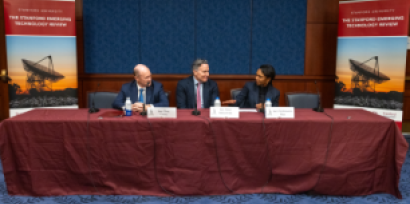
Stanford and Hoover Institution contributors to the Stanford Emerging Technology Review are seen on Capitol Hill on February 25, 2025. (DMV Productions)
News
Books
Stanford Emerging Technology Review Highlights Promise and Risk of Frontier Tech to Washington, DC Policymakers

Contributors to the 2025 edition of the Stanford Emerging Technology Review brought its findings to America’s capital on February 25, with the challenge and promise presented by frontier technologies now clearer than ever before.

March 11, 2025
Read More
SETR 2025 Cover
News
Books
Stanford Emerging Technology Review Offers Policymakers New Insights

The 2025 edition of the Stanford Emerging Technology Review (SETR) report is now available, offering American policymakers a comprehensive overview of how ten frontier technologies, from artificial intelligence to robotics, are transforming the world.

February 24, 2025
Read More
DeepSeek logo in front of a Chinese flag
Article
Books
How Disruptive Is DeepSeek? Stanford HAI Faculty Discuss China’s New Model

Experts weigh in on the implications of DeepSeek’s open-source model and its impact on technology, geopolitics, the arts, and more.

February 13, 2025 by Amy Zegart
Read More
The Interconnect Logo
News
Books
CFR and the Stanford Emerging Technology Review Launch New Podcast Series on Frontier Technologies

Frontier technologies are transforming international relations and the U.S. economy. As a result, more bridges between science and engineering labs, Washington, DC, and the world of business are needed. The Hoover Institution and Stanford University’s School…

February 12, 2025
Read More
SETR in DC | Feb. 25, 2025
Events
Books
The Stanford Emerging Technology Review 2025: Frontier Tech For A New Geopolitical Era

The Hoover Institution and the School of Engineering at Stanford University invite you to a panel discussion for the launch of the Stanford Emerging Technology Review 2025 report in Washington, DC.

Read More
Hoover Institution fellow Drew Endy testifies before the US-China Economic and Security Review Commission at a hearing on "Made in China 2025—Who Is Winning?"
News
Books
Drew Endy: Made In China 2025—Who Is Winning?

Hoover Institution fellow Drew Endy testifies before the US-China Economic and Security Review Commission at a hearing on "Made in China 2025—Who Is Winning?"

February 06, 2025 by Drew Endy
Read More
Bio-Strategies and Leadership Holds Inaugural Congressional Fellowship Program on Biotechnology Strategy
Events
Books
Bio-Strategies and Leadership Holds Inaugural Congressional Fellowship Program on Biotechnology Strategy

Drew Endy, a Hoover science fellow and senior fellow and Martin Family University Fellow in Undergraduate Education (Bioengineering) at Stanford University, convened nearly two dozen Hoover and Stanford experts, policymakers, and business leaders earlier this…

October 18, 2024
Read More
Tech Track II 2024
Events
Books
Government Officials, Hoover Fellows, and Silicon Valley Leaders Discuss Cooperation at Sixth Annual Tech Track II Symposium

Fifty US government officials, scholars from the Hoover Institution, Stanford University scientists and engineers, technology experts, venture capitalists, and business leaders convened at the Sixth Annual Tech Track II Symposium hosted by the Hoover…

December 16, 2024
Read More
Drone
Article
Books
Technology Applications By Policy Area

This chapter explores applications from each of the ten technology fields described in the report as they may relate to five important policy themes: economic growth, national security, environmental and energy sustainability, health and medicine, and civil…

February 07, 2025
Read More
Globe
Article
Books
Cross-Cutting Themes

One of the most important and unusual hallmarks of this moment is convergence: emerging technologies are intersecting and interacting in a host of ways, with important implications for policy. This chapter identifies themes and commonalities that cut across…

February 07, 2025

You May Also Like

.
Director Rice, Senators Coons, and McCormick in conversation during their panel session.
The 2026 Stanford Emerging Technology Review Debuts In The Nation’s Capital
.
SETR 2026 Cover
2026 Edition Of The Stanford Emerging Technology Review Offers Policymakers And Business Leaders New Insights Into The Implications Of Frontier Technologies.
.
Drone
Technology Applications By Policy Area
.
Globe
Cross-Cutting Themes
.
Binary
Foreword
.
Stanford
Executive Summary
overlay image