






.
biotech
biotech
Biotechnology and Synthetic Biology
.
cryptography
crypto
Cryptography
.
materialscience
nano
Materials Science
.
Lasers
Lasers
Lasers
.
neuroscience
neuroscience
Neuroscience
.
robotics
robotics
Robotics
.
semiconductor
semiconductors
Semiconductors
.
space
space
Space
.
Sustainable-Energy-Technologies_133px.jpg
energy
Sustainable Energy Technologies

Key Takeaways

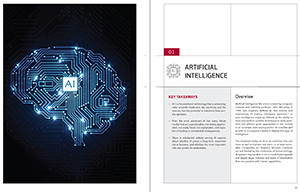
•   Artificial intelligence (AI) is a foundational technology that is supercharging other scientific fields and, like electricity and the internet, has the potential to transform societies, economies, and politics worldwide.

•   Despite rapid progress in the past several years, even the most advanced AI still has many failure modes that are unpredictable, not widely appreciated, not easily fixed, not explainable, and capable of leading to unintended consequences.

•   Mandatory governance regimes for AI, even those to stave off catastrophic risks, will face stiff opposition from AI researchers and companies, but voluntary regimes calling for self-governance are more likely to gain support.

Icons_card_AI.png

Overview

Artificial intelligence (AI) is the ability of computers to perform functions associated with the human brain, including perceiving, reasoning, learning, interacting, problem solving, and exercising creativity. AI promises to be a fundamental enabler of technological advancement and progress in many fields, arguably as important as electricity or the internet. In 2024, the Nobel Prizes for Physics and Chemistry were awarded for work intimately related to AI.

Three of the most important subfields of AI are computer vision, machine learning, and natural language processing. The boundaries between them are often fluid.

  • Computer vision (CV) enables machines to recognize and understand visual information, convert pictures and videos into data, and make decisions based on the results. 

  • Machine learning (ML) enables computers to perform tasks without explicit instructions, often by generalizing from patterns in data. ML includes deep learning that relies on multilayered artificial neural networks to model and understand complex relationships within data. 

  • Natural language processing (NLP) equips machines with capabilities to understand, interpret, and produce spoken words and written texts.

Although AI draws on other subfi elds, it is mostly based on machine learning (ML), which requires data and computing power, often on an enormous scale. Data can take various forms, including text, images, videos, sensor readings, and more. The quality and quantity of data play a crucial role in determining the performance and capabilities of AI models. Models may generate inaccurate or biased outcomes, especially in the absence of suffi cient high-quality data. Furthermore, the hardware costs of training leading AI models are substantial. Currently, only a select number of large US companies have the resources to build cutting-edge models from scratch.


Key Developments

Dominating the AI conversation in 2024 were foundation models, which are large-scale systems trained on very large volumes of diverse data. Such training endows them with broad capabilities, and they can apply knowledge learned in one context to a different context, making them more flexible and efficient than traditional task-specific models.

Large language models (LLMs) are the most familiar type of foundation model and are trained on very large amounts of text. LLMs are an example of generative AI, which can produce new material based on its training and the inputs it is given using statistical prediction about what other words are likely to be found immediately after the occurrence of certain words. These models generate linguistic output surprisingly similar to that of humans across a wide range of subjects, including computer code, poetry, legal case summaries, and medical advice. Specialized foundation models have also been developed in other modalities such as audio, video, and images.
 

Over the Horizon

AI OPPORTUNITIES    

AI users will not be limited to those with specialized training; instead, the average person will interact directly with sophisticated AI applications for a multitude of everyday activities. While AI can automate a wide range of tasks, it promises to enable people to do what they are best at doing. AI systems can work alongside humans, complementing and assisting them. Key sectors poised to take advantage of the technology include healthcare, agriculture, law, and logistics and transportation. 

AI Risks 

One challenge of implementing AI is managing the risks associated with the technology. Some of the known issues with leading AI models include: 

  • Explainability Today’s AI is for the most part incapable of explaining how it arrives at a specific conclusion. Explanations are not always necessary, but in cases such as medical decision-making, they may be critical.

  • Bias and fairness Machine learning models are trained on existing datasets, which means that any bias in the data can skew results.

  • Vulnerability to spoofing For many AI models, data inputs can be tweaked to fool them into drawing false conclusions. 

  • Deepfakes AI provides the capability for generating highly realistic but entirely inauthentic audio and video, with concerning implications for courtroom evidence and political deception.

  • Overtrust As trust in AI grows, the risk of overlooking errors, mishaps, and unforeseen incidents also increases. 

  • Hallucinations AI models can generate results or answers that seem plausible but are completely made up, incorrect, or both.

A second challenge is the future of work in an AI-enabled context. AI models have already demonstrated how they can be used in a wide variety of fields, including law, customer support, coding, and journalism, leading to concerns that the impact of AI on employment will be substantial, especially on jobs that involve knowledge work. In some cases, the technology will help workers to increase their productivity and job satisfaction. In others, AI will lead to job losses—and it is not yet clear what new jobs will arise to take their place.


POLICY, LEGAL & REGULATORY ISSUES

Research on foundational AI technologies is difficult to regulate, even among likeminded nations. It is even more difficult, and may well be impossible, to reach agreement between nations that regard each other as strategic competitors and adversaries. The same logic applies to voluntary restrictions on research by companies that compete with each other. Regulation of specific applications of AI may be more easily implemented, in part because of existing regulatory frameworks in domains such as healthcare, finance, and law.

Over the past couple of years, nations have explored possible governance regimes. In the United States, the president’s Executive Order on the Safe, Secure, and Trustworthy Development and Use of Artificial Intelligence was issued on October 30, 2023. In November 2023 and May 2024, the European Union and twenty-eight nations collectively endorsed international cooperation to manage risks associated with highly capable general-purpose AI models. The European Union’s AI Act entered into force in August 2024.

Report Preview: Artificial Intelligence

Faculty Council Advisor

fei-fei-li_profilephoto.jpg
Fei-Fei Li
Author
Fei-Fei Li

Fei-Fei Li is the Sequoia Professor of Computer Science and professor, by courtesy, of psychology at Stanford University. She serves as codirector of Stanford’s Human-Centered AI Institute and as an affiliated faculty at Stanford Bio-X. Her current research includes cognitively inspired AI, machine learning, computer vision, and ambient intelligent systems for health-care delivery. She received her PhD in electrical engineering from the California Institute of Technology.

View Bio
fei-fei-li_profilephoto.jpg
Fei-Fei Li

Fei-Fei Li is the Sequoia Professor of Computer Science and professor, by courtesy, of psychology at Stanford University. She serves as codirector of Stanford’s Human-Centered AI Institute and as an affiliated faculty at Stanford Bio-X. Her current research includes cognitively inspired AI, machine learning, computer vision, and ambient intelligent systems for health-care delivery. She received her PhD in electrical engineering from the California Institute of Technology.

Access the Complete Report

Read the complete report.

Explore

Date Range
CONTENT TYPE

Select Content Type

  • News
  • Article
  • Videos
  • Podcasts
  • Events
AUTHORS

Select Author

  • Condoleezza Rice
  • John Taylor
  • Jennifer Widom
  • Amy Zegart
  • Herbert Lin
  • Hon. Jerry McNerney
  • Hon. Robert Gates
  • Hon. Steven Chu
  • Hon. Susan M. Gordon
  • John Hennessy
  • Lloyd B. Minor
  • Mary Meeker
  • Peter Scher
  • Thomas M. Siebel
  • Zhenan Bao
  • Dan Boneh
  • Yi Cui
  • Simone D’Amico
  • Drew Endy
  • Siegfried Glenzer
  • Mark A. Horowitz
  • Fei-Fei Li
  • Allison Okamura
  • Kang Shen
  • Eric Schmidt
  • Steven Koonin
  • Sally Benson
  • Norbert Holtkamp
  • Martin Giles
  • Jon Simon
FOCUS AREAS

Artificial Intelligence

  • Artificial Intelligence
  • Biotechnology and Synthetic Biology
  • Sustainable Energy Technologies
  • Cryptography
  • Materials Science
  • Neuroscience
  • Nuclear Technologies
  • Robotics
  • Semiconductors
  • Space
  • Technology Test Page
  • Lasers
  • Artificial Intelligence
  • Biotechnology and Synthetic Biology
  • Cryptography
  • Materials Science
  • Neuroscience
  • Robotics
  • Semiconductors
  • Sustainable Energy Technologies
  • Space
  • Artificial Intelligence
  • Biotechnology and Synthetic Biology
  • Cryptography and Computer Security
  • Materials Science
  • Neuroscience
  • Robotics
  • Semiconductors
  • Space
  • Energy Technologies
  • Quantum Technologies
Date (field_date)
Read More
test
Events
Books
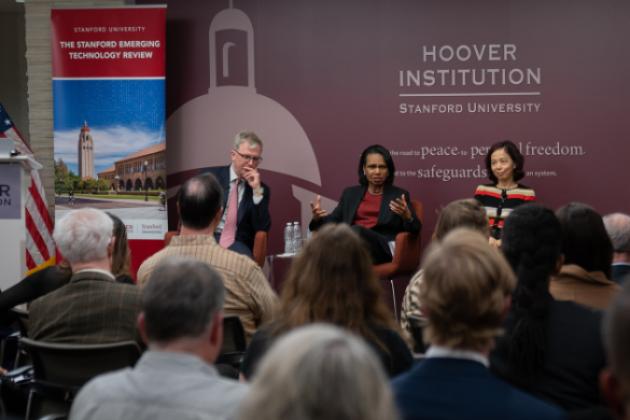
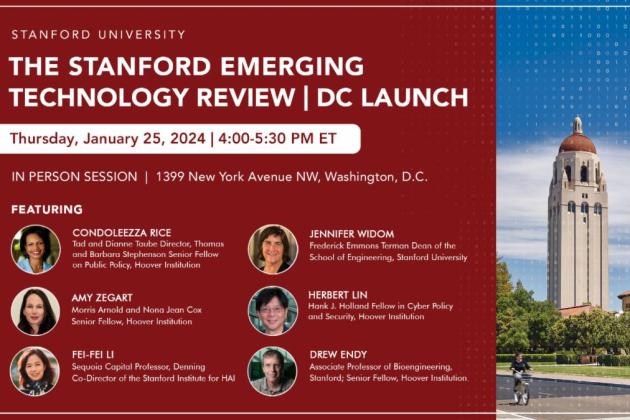
The Stanford Emerging Tech Review | DC Launch

The Hoover Institution and the School of Engineering at Stanford University invite you to the DC launch of the Stanford Emerging Technology Review at the Hoover DC office on Thursday, January 25th, from 4:00 PM - 5:30 PM ET.

January 25, 2024
Read More
Artificial Intelligence
News
Books
Stanford aims to help policy makers prepare for AI, robotics and more

A new project from Stanford University aims to help policymakers get their heads around a range of fast-developing new technologies, from AI and cryptography to robotics and synthetic biology.

December 11, 2023
Read More
Artificial Intelligence
News
Books
Stanford launches emerging-tech project co-led by Hoover Institution’s Condoleezza Rice

Former U.S. Secretary of State Condoleezza Rice is helping lead a new Stanford University initiative to provide “one-stop shopping” for government, businesses and the public to obtain timely information about new and evolving technologies.

December 08, 2023
Read More
Hoover research fellow Herbert Lin, the director and editor-in-chief of the Stanford Emerging Technology Review explains that advancements in a single field of emerging technology leads to advancements in others.
News
Books
Hoover Institution and School of Engineering launch emerging technology review

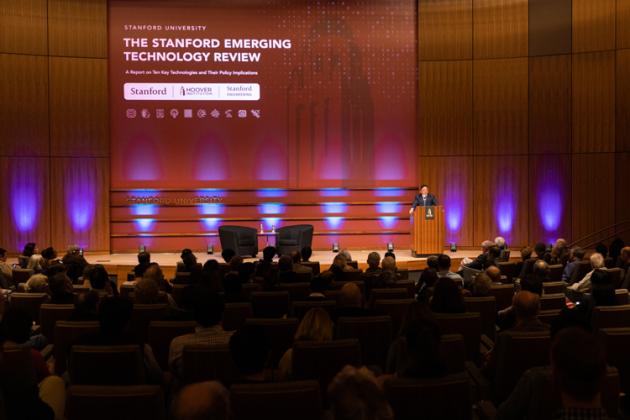
The Stanford Emerging Technology Review (SETR), a “one-stop-shopping primer” for policymakers on advancements in 10 key emerging technology areas, launched its first report in November.

December 08, 2023
Read More
SETR_SplashScreen_705px.jpg
News
Books
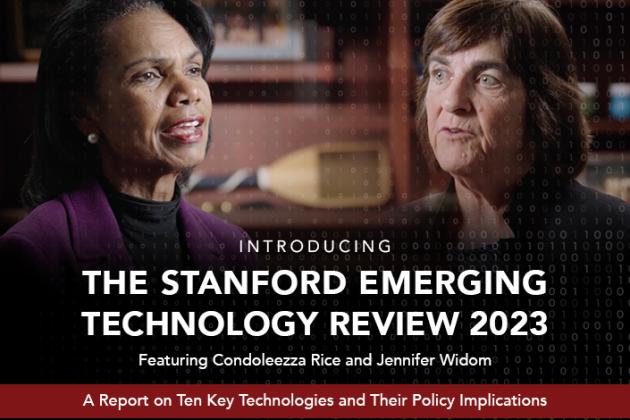
Introducing the Stanford Emerging Technology Review featuring Condoleezza Rice and Jennifer Widom

Introducing the Stanford Emerging Technology Review, an innovative project and publication dedicated to exploring the breakthroughs and policy implications of cutting-edge technologies that are shaping our societies and economies.In this video, the Review’s…

December 05, 2023 by Condoleezza Rice, Jennifer Widom
Read More
Solar
Article
Books
Yi Cui to lead Sustainability Accelerator; Roland Horne named interim Precourt Institute director

Cui has been leading both the Sustainability Accelerator and the Precourt Institute for Energy since April. With Horne transitioning to interim director of the Precourt Institute, Cui will continue engaging with the accelerator’s efforts to generate…

November 10, 2023 by Yi Cui
Read More
Science
Article
Books
Stanford professors promote bio-literacy through digital education

Drew Endy and Jenn Brophy take a step toward educating the world about bioengineering with a course offered to high school students nationwide.

September 27, 2023 by Drew Endy
Read More
AI Robot
Article
Books
Stanford AI professor Fei-Fei Li says we need more human-centered technology. Still, she had to convince herself to share her own story

A human story. Stanford professor Fei-Fei Li is an AI technologist known for her work to make the fast-moving technology more human, a crusade she launched via a widely-read 2018 New York Times op-ed. When she started to write a book, she focused on that work—…

November 15, 2023 by Fei-Fei Li
Read More
Robot
Article
Books
AI is at an inflection point, Fei-Fei Li says

The renowned AI researcher shares her thoughts on the hard problems that lie ahead for the field.

November 14, 2023 by Fei-Fei Li
Read More
Artificial Intelligence
Article
Books
Fei-Fei Li Started an AI Revolution by Seeing Like an Algorithm

Researcher Fei-Fei Li’s ImageNet project provided the feedstock for the deep learning boom that brought the world ChatGPT and other world-changing AI systems.

November 10, 2023 by Fei-Fei Li

You May Also Like

.
SETR_booklet_2026_cover.jpg
The Stanford Emerging Technology Review 2026
.
Interplay of digital circuit and number graphics on the subject of electronics, computers, communications and modern technologies.
How Emerging Technologies Take Shape
.
technologyabstract
The Care and Feeding of Transformative Tech
.
artificial intelligence istock
Artificial Intelligence: Supercharging Science
.
SETR AI Video
The Future of Artificial Intelligence
.
Stanford and Hoover Institution contributors to the Stanford Emerging Technology Review are seen on Capitol Hill on February 25, 2025. (DMV Productions)
Stanford Emerging Technology Review Highlights Promise and Risk of Frontier Tech to Washington, DC Policymakers
.
SETR 2025 Cover
Stanford Emerging Technology Review Offers Policymakers New Insights
.
DeepSeek logo in front of a Chinese flag
How Disruptive Is DeepSeek? Stanford HAI Faculty Discuss China’s New Model
.
The Interconnect Logo
CFR and the Stanford Emerging Technology Review Launch New Podcast Series on Frontier Technologies
.
SETR in DC | Feb. 25, 2025
The Stanford Emerging Technology Review 2025: Frontier Tech For A New Geopolitical Era
.
Bio-Strategies and Leadership Holds Inaugural Congressional Fellowship Program on Biotechnology Strategy
.
Tech Track II 2024
Government Officials, Hoover Fellows, and Silicon Valley Leaders Discuss Cooperation at Sixth Annual Tech Track II Symposium
.
Stanford
Executive Summary
overlay image