








.
AI_133px.jpg
ai
Artificial Intelligence
.
biotech
biotech
Biotechnology and Synthetic Biology
.
cryptography
crypto
Cryptography and Computer Security
.
materialscience
nano
Materials Science
.
neuroscience
neuroscience
Neuroscience
.
Quantum Technologies
.
robotics
robotics
Robotics
.
semiconductor
semiconductors
Semiconductors
.
space
space
Space

KEY TAKEAWAYS

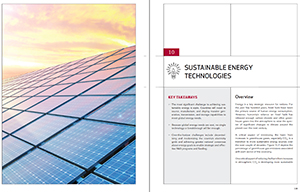
•   Although many clean energy technologies are now available and increasingly affordable, scaling them up and building the infrastructure for them will take decades due to infrastructure inertia, stakeholder complexity, and the “energy trilemma,” which balances reliability, affordability, and cleanliness.

•   The US has shifted from climate urgency to energy dominance, redirecting support from renewables and electric vehicles to fission, coal, and natural gas. Globally, similar trends prevail as nations record peak fossil fuel use and scale back renewable investments, prioritizing energy security over decarbonization.

•   Energy innovation is fragmented, diverse, and geopolitically strategic, with progress in technologies like fission, geothermal, fusion, and batteries reshaping the energy frontier. To compete with China, US technology leadership depends on sustained R&D funding, robust supply chains, and strategic industrial policies.

Icons_card_Energy.png

Overview

Energy is essential to modern life, enabling heating, cooling, transportation, lighting, information, and material production. Global energy demand is projected to grow by 50 percent between 2020 and 2050, driven by billions of people in developing countries improving their living standards. The energy “trilemma” requires energy systems to provide reliable, affordable, and clean energy, but no single source satisfies all three requirements perfectly: Coal is reliable and cheap but polluting; renewables are clean and cheap but intermittent; nuclear is clean and reliable but costly. In response, a flurry of innovation has arisen to lower costs and increase reliability and availability; although research today will not affect the trilemma in the near term, it is laying the foundation for a sounder energy future in the long run. 

Despite the rapid growth of renewables, hydrocarbons still supplied 86 percent of primary energy globally in 2024. Long asset lifetimes, integration challenges, and conflicting stakeholder interests impede efforts to change large, complex energy systems. Efficiency improvements can be offset by increased use. Innovation in energy must produce fuel or electricity at costs competitive with existing options. Renewables face challenges—backup generation costs, grid management issues, fire risks in battery storage, and dependence on critical imported materials—that impede rapid transition.


KEY DEVELOPMENTS

In recent years, electrical demand has surged, driven by data centers, artificial intelligence (AI) workloads, cryptocurrency mining, electric vehicles (EVs), heat pumps, and industrial reshoring, with growth exceeding 2 percent annually for three consecutive years. Forecasts anticipate a 16 to 25 percent rise over five years, straining grid capacity and necessitating new generation. Investments have been shifting from intermittent solar and wind to natural gas, nuclear, and energy storage. Nuclear power, projected to triple capacity by 2050, is increasingly being paired with digital infrastructure like AI data centers. However, supply chain risks associated with high-assay low-enriched uranium, historically imported from Russia, pose challenges. New investments aim to expand domestic enrichment capabilities. Coal is also gaining renewed policy attention and interest for its domestic availability and reliability.

These trends, many predating the current US administration, reveal a pragmatic shift toward affordable, reliable energy over rapid emissions reduction. Globally, fossil fuel consumption hit record highs in 2024 with rising carbon dioxide (CO₂) emissions, while geopolitical tensions and market dynamics weakened decarbonization-friendly policies. Despite pledges for carbon neutrality, countries like China and India continue significant coal build-outs.
 

Over the Horizon

The technological future for energy is rich and varied. SETR 2025 took note of long-duration energy storage from intermittent sources, renewable combustible hydrocarbons and biodiesel, technologies for capturing and storing atmospheric CO₂ underground, and new electric grid technologies for managing a variety of renewable energy sources and dealing with increased electricity demand. 

SETR 2026 addresses the following: 

Iron-Air Batteries Batteries are used to store energy generated by intermittent wind and solar energy sources. Iron-air batteries are a promising alternative to widely used lithium-ion (Li-ion) ones because of their lower cost and higher energy storage durations. Such batteries will complement, not replace, Li-ion systems and reduce dependency on Chinese-controlled lithium supply chains. 

Transportation Electrification Although the United States has eliminated the tax incentives for EVs and associated charging infrastructure, the electrification of light-duty transport continues apace in other parts of the world. Certain EV technologies, such as batteries, are currently dominated by Chinese suppliers. In April 2025, a Chinese company announced that its latest EV battery could add 323 miles of driving range with five minutes of charging, a significant improvement in EV battery range and charging speed. 

Green Hydrogen Hydrogen is expected to play a major role in a decarbonized future. Currently, most hydrogen is produced via processes that emit a substantial amount of CO₂. Green hydrogen is produced by electrolysis of water using renewable energy. Although this process is about two to three times as expensive as other approaches, its cost is falling significantly, and global capacity increased by a factor of more than twenty-five from 2021 to 2024. 

Geothermal Energy This energy source uses the Earth’s internal heat for steam that can provide reliable, clean power independent of weather conditions. Steam comes directly from geothermal springs or is produced by injecting water into hot, dry underground rock. Geothermal energy could supply a substantial portion of America’s electricity by 2050 if costs fall and federal support continues. Recent US policy actions have accelerated permitting and development.

Small Modular Reactors A small modular reactor (SMR) is a compact nuclear fission reactor producing up to 300 megawatts of electricity that is designed for factory fabrication and modular installation. Multiple US start-ups are seeking to commercialize advanced SMRs with reactor technologies that prioritize safety through passive systems that use gravity, natural circulation, and convection to maintain safe reactor conditions without external power, active controls, or operator intervention. 

Nuclear Fusion Fusion promises clean, abundant power with minimal long-lived radioactive waste. Fusion demonstrations in 2022 and 2025 saw promising net energy gains, but much higher gains are needed for commercial viability. (Gain occurs when the energy output of fusion exceeds the input needed to initiate it.) Other hurdles involve developing durable materials to withstand damage caused by plasma and breeding enough tritium fuel, which today must be manufactured in nuclear fission reactors. Most importantly, the cost of electricity generated must be competitive with alternatives. Most knowledgeable observers believe viable fusion power won’t happen until 2040.

POLICY ISSUES

Changing Priorities

The past year has seen a significant shift in US energy policy toward prioritizing energy abundance, industrial competitiveness, and grid reliability over strict decarbonization goals. Tax credits for wind and solar have been removed, while support for nuclear, geothermal, and natural gas has increased. Executive orders accelerated fossil fuel leasing, streamlined pipeline approvals, and aimed to sunset outdated regulations. Dozens of regulations have been eliminated or modified to ease burdens on the energy sector. Sunset clauses have been implemented to review energy regulations, adding uncertainty to transmission and market rules. Emission enforcement has been scaled back and the foundational Endangerment Finding for greenhouse gases has been targeted for revocation. Licensing pathways for SMRs and microreactors have been accelerated.

Supply Chain Issues

Challenges related to lithium and other critical minerals pose a risk to the long-term success of domestic Li-ion EV battery production. China has imposed regulations on exporting various critical minerals, which could gravely impact American access to the materials necessary to build EVs and other sustainable technologies. Many companies are concerned about the long-term availability of these materials.

REPORT PREVIEW: Sustainable Energy Technologies

Faculty Council Advisor

yi-cui_profilephoto.jpg
Yi Cui
Author
Yi Cui

Yi Cui is the director of the Precourt Institute for Energy, the Fortinet Founders Professor of materials science and engineering, and professor of energy science and engineering and, by courtesy, of chemistry at Stanford University. He is also a senior fellow at the Stanford Woods Institute for the Environment and codirector of Stanford StorageX Initiative. His research focuses on nanomaterials, nanobiotechnology, and nanoenvironmental technologies. He received his PhD in chemistry from Harvard University.

View Bio
yi-cui_profilephoto.jpg
Yi Cui

Yi Cui is the director of the Precourt Institute for Energy, the Fortinet Founders Professor of materials science and engineering, and professor of energy science and engineering and, by courtesy, of chemistry at Stanford University. He is also a senior fellow at the Stanford Woods Institute for the Environment and codirector of Stanford StorageX Initiative. His research focuses on nanomaterials, nanobiotechnology, and nanoenvironmental technologies. He received his PhD in chemistry from Harvard University.

Access the Complete Report

Read the complete report.

Explore

Date Range
CONTENT TYPE

Select Content Type

  • News
  • Article
  • Videos
  • Podcasts
  • Events
AUTHORS

Select Author

  • Condoleezza Rice
  • John Taylor
  • Jennifer Widom
  • Amy Zegart
  • Herbert Lin
  • Hon. Jerry McNerney
  • Hon. Robert Gates
  • Hon. Steven Chu
  • Hon. Susan M. Gordon
  • John Hennessy
  • Lloyd B. Minor
  • Mary Meeker
  • Peter Scher
  • Thomas M. Siebel
  • Zhenan Bao
  • Dan Boneh
  • Yi Cui
  • Simone D’Amico
  • Drew Endy
  • Siegfried Glenzer
  • Mark A. Horowitz
  • Fei-Fei Li
  • Allison Okamura
  • Kang Shen
  • Eric Schmidt
  • Steven Koonin
  • Sally Benson
  • Norbert Holtkamp
  • Martin Giles
  • Jon Simon
FOCUS AREAS

Energy Technologies

  • Artificial Intelligence
  • Biotechnology and Synthetic Biology
  • Sustainable Energy Technologies
  • Cryptography
  • Materials Science
  • Neuroscience
  • Nuclear Technologies
  • Robotics
  • Semiconductors
  • Space
  • Technology Test Page
  • Lasers
  • Artificial Intelligence
  • Biotechnology and Synthetic Biology
  • Cryptography
  • Materials Science
  • Neuroscience
  • Robotics
  • Semiconductors
  • Sustainable Energy Technologies
  • Space
  • Artificial Intelligence
  • Biotechnology and Synthetic Biology
  • Cryptography and Computer Security
  • Materials Science
  • Neuroscience
  • Robotics
  • Semiconductors
  • Space
  • Energy Technologies
  • Quantum Technologies
Date (field_date)
Read More
Space
Article
Books
A Deeper Dive into Space

Stanford University experts survey the aeronautics and astronautics research landscape on campus, covering topics including multisatellite autonomy; in-space logistics, servicing, assembly, and manufacturing (ISAM); space sustainability; spacecraft systems and…

June 17, 2024 by Herbert Lin, Simone D’Amico
Read More
Semiconductor Day at the Hoover Institution
News
Books
Experts, Diplomats, and Industry Representatives Discuss US Semiconductor Future after Passage of CHIPS Act

As dollars from the CHIPS and Science Act flow to strengthen the US semiconductor industry, senior leaders from the US government, industry, academia, and international partners met at the Hoover Institution to discuss current challenges and the field’s next…

June 13, 2024
Read More
SETR_CongressionalFellowship
News
Books
Stanford Emerging Technology Review Congressional Fellowship Program

The Hoover Institution and Stanford School of Engineering appreciate the important role of Congressional staff as they advise Members on the critically important policy issues that routinely come before Congress.

March 21, 2024
Read More
Space Innovation Roundtable
News
Books
Senior Leaders in Government, Industry, and Academia Convene for Discussions on Space Innovation and Commercial Integration
March 08, 2024
Read More
Artificial Intelligence
News
Books
US Wants Cloud Firms to Report Foreign Users Building AI

US Commerce Secretary Gina Raimondo said her department is exploring how to force cloud companies to disclose when a foreigner taps their computing power to fuel artificial intelligence applications, signaling the next phase of the tech war between Washington…

January 26, 2024
Read More
artificial intelligence
News
Books
Raimondo considers cloud reporting rules for foreign AI developers

Commerce Secretary Gina Raimondo said Friday that she is considering requiring cloud server providers to report details on whether foreign users are developing artificial intelligence models, an extension of the Biden administration’s efforts to institute AI…

January 29, 2024
Read More
artificial intelligence
News
Books
OpenAI and Other Tech Giants Will Have to Warn the US Government When They Start New AI Projects

The Biden administration is using the Defense Production Act to require companies to inform the Commerce Department when they start training high-powered AI algorithms.

January 26, 2024 by Condoleezza Rice, Fei-Fei Li
Read More
technologyiStock-1328282379
Videos
Books
Commerce Secretary and Others on AI and Innovation

Commerce Secretary Gina Raimondo, former Secretary of State Condoleezza Rice, and Stanford University computer scientist Fei-Fei Li discussed artificial intelligence and technological innovation at an event hosted by the Hoover Institution in Washington, DC.…

January 26, 2024 by Condoleezza Rice, Fei-Fei Li
Read More
SETR
News
Books
Stanford Emerging Technology Review Launches in Washington DC

Contributor scholars, Stanford engineers all, of the Stanford Emerging Technology Review brought their insights to the nation’s capital last week, launching the initiative with events in the nation’s capital.

January 29, 2024
Read More
technologyiStock-1328282379
Events
Books
A Conversation On The State Of Scientific And Technological Innovation

The U.S. Department of Commerce, together with the Hoover Institution and Stanford School of Engineering, invite you to a conversation on the state of scientific and technological innovation and the launch of Stanford Emerging Technology Review at JP Morgan…

January 26, 2024

You May Also Like

.
Director Rice, Senators Coons, and McCormick in conversation during their panel session.
The 2026 Stanford Emerging Technology Review Debuts In The Nation’s Capital
.
SETR 2026 Cover
2026 Edition Of The Stanford Emerging Technology Review Offers Policymakers And Business Leaders New Insights Into The Implications Of Frontier Technologies.
.
Drone
Technology Applications By Policy Area
.
Globe
Cross-Cutting Themes
.
Binary
Foreword
.
Stanford
Executive Summary
overlay image