









.
AI_133px.jpg
ai
Artificial Intelligence
.
biotech
biotech
Biotechnology and Synthetic Biology
.
Sustainable-Energy-Technologies_133px.jpg
energy
Energy Technologies
.
materialscience
nano
Materials Science
.
neuroscience
neuroscience
Neuroscience
.
Quantum Technologies
.
robotics
robotics
Robotics
.
semiconductor
semiconductors
Semiconductors
.
space
space
Space

KEY TAKEAWAYS

•  Cryptography is essential for protecting information, but alone it cannot secure cyberspace against all threats; it must operate in concert with the broader field of computer security.

•  Cryptography is the enabling technology of blockchain, which is the enabling technology of cryptocurrencies.

•  Rather than pursue a central bank digital currency, the United States has adopted a policy preference for privately issued digital assets, promoting stablecoins and cryptocurrencies as vehicles for financial innovation and resilience.

Icons_card_Crypto.png

Overview

Cryptography refers to the mathematics of protecting data from being surreptitiously altered or accessed inappropriately. It is essential for most internet activity, including messaging, e-commerce, and banking. There are two main types of cryptography: symmetric and asymmetric. Symmetric cryptography requires both parties to share one secret key to encrypt and decrypt data. In practice, sharing this secret key can be difficult. This has led to the development of asymmetric encryption, which uses one public key, freely available to anyone, to encrypt data and uses a different private key to decrypt data. Hashing is another cryptographic method that generates a unique fixed-length string of numbers for a given input. Through the combination of hashing and other techniques, cryptography also enables identity verification and allows a recipient to confirm that a message was not altered in transit.


KEY DEVELOPMENTS

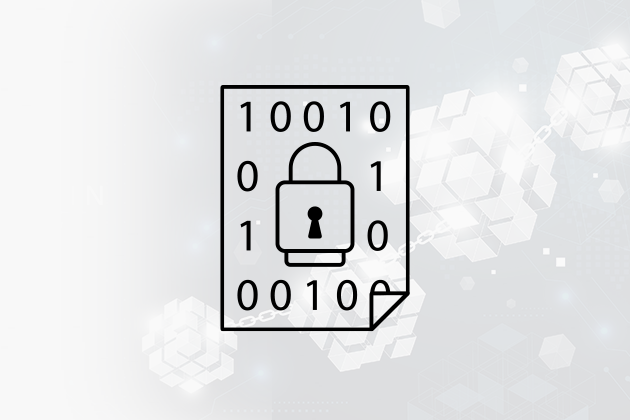
Blockchain Blockchain technology employs cryptography to create a ledger that is secure and immutable. Each digital block in the blockchain contains a transaction and a cryptographic hash of the previous block, forming a chain. In this way, the blockchain is immutable, since changing earlier blocks would change the hashes and be easily detected. Blockchain technology has been applied to a variety of use cases including identity management, supply chain management, smart contracts, transactional records, and cryptocurrencies.

Secure Computation Secure computation, based on cryptography, enables multiple parties to contribute inputs to a function that they jointly compute without sharing their individual inputs with each other. Secure computation is extremely useful in financial and health settings where sharing individual client or patient data is unethical or even illegal.

Within secure computation are zero-knowledge proofs, which are cryptographic methods that allow one person to prove to someone else that he or she knows a specific piece of information without revealing to the other person any details about that information. The term “zero knowledge” indicates that the receiver gains no new knowledge about the information in question, except that what the prover is saying is true. Zero-knowledge proofs have applications in banking, where a buyer may wish to prove to a seller the possession of sufficient funds for a transaction without revealing the exact amount of those funds. Other applications range from cooperative tracking and verification of numbers of tactical nuclear warheads to checking the provenance of digital images.

 

Over the Horizon

Impact of Cryptography There are a broad range of possibilities for cryptographically enabled data management services, but whether we will see their widespread deployment depends on complicated decisions about economic feasibility, costs, regulations, and ease of use. Misaligned incentives at companies (which have strong incentives to gather consumer data) and the difficulties of consumer and policymaker education present challenges to widespread adoption. Extensive deployment will also require would-be users to have confidence that proposed innovations will work as advertised. However, the mathematical and counterintuitive nature of cryptography concepts will make it challenging for policymakers, consumers, and regulators to place their trust in these applications. 

Machine Learning Security As machine learning (ML) systems are integrated into critical domains like healthcare and autonomous vehicles, significant adversarial risks and systemic vulnerabilities will emerge. Malicious actors may be able to make subtle, almost imperceptible changes to inputs and training data that can cause large, unexpected ML failures, undermining trust and safety. These adversarial attacks can occur at all stages of ML, from corrupting training data to manipulating inputs at inference—the stage where models generate predictions, outputs, or decisions based on new inputs. Such attacks can deceive models into errors that would be obvious to humans, such as misclassifying objects or executing harmful commands. 

Emerging defenses include hardware safeguards, software isolation, and controlled decision flows, but these remain immature and incomplete, leaving ML systems vulnerable in an ongoing arms race between defenders and malicious attackers. Effective security requires verifiable, auditable training pipelines to counter adversarial inputs. Given rapidly evolving attack techniques, ML deployments will need to address adversarial threats up front to ensure safe, reliable, and trustworthy operation.

POLICY ISSUES

Cryptocurrencies

The most significant policy development related to cryptography has been the emergence of a new approach to cryptocurrencies, which use blockchain technology to create digital tokens that can act as a form of currency. The Trump administration has shifted away from policies that might support a central bank digital currency and toward a regulatory framework to facilitate the integration of private cryptocurrencies into the economy.

For example, the Guiding and Establishing National Innovation for US Stablecoins (GENIUS) Act created regulations for issuing stablecoins—cryptocurrencies that are designed to have stable prices—backed by reserve assets such as Treasury bills and precious metals rather than algorithmic mechanisms to enhance their price stability. The Digital Asset Market Clarity Act designated the Commodity Futures Trading Commission as the primary regulator for digital commodities while excluding stablecoins and securities from its remit.

Cryptography

While there has been no push to regulate basic research in cryptography for several decades, a number of aspects of the field raise important policy issues:

Exceptional access (EA) EA refers to a requirement that forces communications carriers and technology vendors to provide US law enforcement agencies access to encrypted information under specific legal conditions. Opponents argue that EA would inevitably weaken the security afforded by encryption to everyone, while supporters argue that the price of weakened security is worth the benefits to law enforcement.

Quantum computing When realized, this novel form of computing is likely to pose a significant threat to today’s public-key algorithms, and the US government has already initiated a transition to quantum-resistant ones. Continuing support for this transition is needed to protect sensitive information.

Research Support

Although cryptography is a fundamentally mathematical discipline, it relies on both human talent and computing power, with interdisciplinary centers advancing research through collaboration. Research can be funded by both the US government and private industry, but onerous proposal requirements make government funding far more difficult to achieve at present. However, only the US government is capable of funding research that may not pay off for many years.

Report Preview: Cryptography

Faculty Council Advisor

dan-boneh_profilephoto.jpg
Dan Boneh
Author
Dan Boneh

Dan Boneh is professor of cryptography and electrical engineering at Stanford University, codirector of the Stanford Computer Security Lab, and a senior fellow at the Freeman Spogli Institute for International Studies. His research focuses on applied cryptography and computer security. He has authored over one hundred publications. He received his PhD in computer science from Princeton University.

View Bio
dan-boneh_profilephoto.jpg
Dan Boneh

Dan Boneh is professor of cryptography and electrical engineering at Stanford University, codirector of the Stanford Computer Security Lab, and a senior fellow at the Freeman Spogli Institute for International Studies. His research focuses on applied cryptography and computer security. He has authored over one hundred publications. He received his PhD in computer science from Princeton University.

Access the Complete Report

Read the complete report.

Explore

Date Range
CONTENT TYPE

Select Content Type

  • News
  • Article
  • Videos
  • Podcasts
  • Events
AUTHORS

Select Author

  • Condoleezza Rice
  • John Taylor
  • Jennifer Widom
  • Amy Zegart
  • Herbert Lin
  • Hon. Jerry McNerney
  • Hon. Robert Gates
  • Hon. Steven Chu
  • Hon. Susan M. Gordon
  • John Hennessy
  • Lloyd B. Minor
  • Mary Meeker
  • Peter Scher
  • Thomas M. Siebel
  • Zhenan Bao
  • Dan Boneh
  • Yi Cui
  • Simone D’Amico
  • Drew Endy
  • Siegfried Glenzer
  • Mark A. Horowitz
  • Fei-Fei Li
  • Allison Okamura
  • Kang Shen
  • Eric Schmidt
  • Steven Koonin
  • Sally Benson
  • Norbert Holtkamp
  • Martin Giles
  • Jon Simon
FOCUS AREAS

Cryptography and Computer Security

  • Artificial Intelligence
  • Biotechnology and Synthetic Biology
  • Sustainable Energy Technologies
  • Cryptography
  • Materials Science
  • Neuroscience
  • Nuclear Technologies
  • Robotics
  • Semiconductors
  • Space
  • Technology Test Page
  • Lasers
  • Artificial Intelligence
  • Biotechnology and Synthetic Biology
  • Cryptography
  • Materials Science
  • Neuroscience
  • Robotics
  • Semiconductors
  • Sustainable Energy Technologies
  • Space
  • Artificial Intelligence
  • Biotechnology and Synthetic Biology
  • Cryptography and Computer Security
  • Materials Science
  • Neuroscience
  • Robotics
  • Semiconductors
  • Space
  • Energy Technologies
  • Quantum Technologies
Date (field_date)
Read More
Space
Article
Books
A Deeper Dive into Space

Stanford University experts survey the aeronautics and astronautics research landscape on campus, covering topics including multisatellite autonomy; in-space logistics, servicing, assembly, and manufacturing (ISAM); space sustainability; spacecraft systems and…

June 17, 2024 by Herbert Lin, Simone D’Amico
Read More
Semiconductor Day at the Hoover Institution
News
Books
Experts, Diplomats, and Industry Representatives Discuss US Semiconductor Future after Passage of CHIPS Act

As dollars from the CHIPS and Science Act flow to strengthen the US semiconductor industry, senior leaders from the US government, industry, academia, and international partners met at the Hoover Institution to discuss current challenges and the field’s next…

June 13, 2024
Read More
SETR_CongressionalFellowship
News
Books
Stanford Emerging Technology Review Congressional Fellowship Program

The Hoover Institution and Stanford School of Engineering appreciate the important role of Congressional staff as they advise Members on the critically important policy issues that routinely come before Congress.

March 21, 2024
Read More
Space Innovation Roundtable
News
Books
Senior Leaders in Government, Industry, and Academia Convene for Discussions on Space Innovation and Commercial Integration
March 08, 2024
Read More
Artificial Intelligence
News
Books
US Wants Cloud Firms to Report Foreign Users Building AI

US Commerce Secretary Gina Raimondo said her department is exploring how to force cloud companies to disclose when a foreigner taps their computing power to fuel artificial intelligence applications, signaling the next phase of the tech war between Washington…

January 26, 2024
Read More
artificial intelligence
News
Books
Raimondo considers cloud reporting rules for foreign AI developers

Commerce Secretary Gina Raimondo said Friday that she is considering requiring cloud server providers to report details on whether foreign users are developing artificial intelligence models, an extension of the Biden administration’s efforts to institute AI…

January 29, 2024
Read More
artificial intelligence
News
Books
OpenAI and Other Tech Giants Will Have to Warn the US Government When They Start New AI Projects

The Biden administration is using the Defense Production Act to require companies to inform the Commerce Department when they start training high-powered AI algorithms.

January 26, 2024 by Condoleezza Rice, Fei-Fei Li
Read More
technologyiStock-1328282379
Videos
Books
Commerce Secretary and Others on AI and Innovation

Commerce Secretary Gina Raimondo, former Secretary of State Condoleezza Rice, and Stanford University computer scientist Fei-Fei Li discussed artificial intelligence and technological innovation at an event hosted by the Hoover Institution in Washington, DC.…

January 26, 2024 by Condoleezza Rice, Fei-Fei Li
Read More
SETR
News
Books
Stanford Emerging Technology Review Launches in Washington DC

Contributor scholars, Stanford engineers all, of the Stanford Emerging Technology Review brought their insights to the nation’s capital last week, launching the initiative with events in the nation’s capital.

January 29, 2024
Read More
technologyiStock-1328282379
Events
Books
A Conversation On The State Of Scientific And Technological Innovation

The U.S. Department of Commerce, together with the Hoover Institution and Stanford School of Engineering, invite you to a conversation on the state of scientific and technological innovation and the launch of Stanford Emerging Technology Review at JP Morgan…

January 26, 2024

You May Also Like

.
Director Rice, Senators Coons, and McCormick in conversation during their panel session.
The 2026 Stanford Emerging Technology Review Debuts In The Nation’s Capital
.
SETR 2026 Cover
2026 Edition Of The Stanford Emerging Technology Review Offers Policymakers And Business Leaders New Insights Into The Implications Of Frontier Technologies.
.
Drone
Technology Applications By Policy Area
.
Globe
Cross-Cutting Themes
.
Binary
Foreword
.
Stanford
Executive Summary
overlay image