








.
AI_133px.jpg
ai
Artificial Intelligence
.
biotech
biotech
Biotechnology and Synthetic Biology
.
cryptography
crypto
Cryptography and Computer Security
.
Sustainable-Energy-Technologies_133px.jpg
energy
Energy Technologies
.
materialscience
nano
Materials Science
.
Quantum Technologies
.
robotics
robotics
Robotics
.
semiconductor
semiconductors
Semiconductors
.
space
space
Space

KEY TAKEAWAYS

•   Advances in human genetics and experimental neuroscience, along with computing and neuroscience theory, have led to some progress in several areas, including understanding and treating addiction and neurodegenerative diseases, and designing brain–machine interfaces for restoring vision.

•   American leadership is essential for establishing and upholding global norms about ethics and human subjects research in neuroscience, but this leadership is slipping with decreased strategic planning and increased foreign investments in the field. 

•   Popular interest in neuroscience vastly exceeds the current scientific understanding of the brain, giving rise to overhyped claims in the public domain that revolutionary advances are just around the corner.

Icons_card_Neuro.png

Overview

Neuroscience is a multidisciplinary field that focuses on the components, functions, and dysfunctions of the human brain and nervous system at every level. It reaches from the earliest stages of embryonic development to dysfunctions and degeneration later in life and from the individual molecules shaping the functions of neurons to the study of the complex system dynamics that drive our thoughts and dictate our behaviors.

Many practical applications could benefit from neuroscience research, including the development of treatments for neurological and psychiatric disorders such as epilepsy, learning disabilities, cerebral palsy, and anxiety, as well as Alzheimer’s disease and other neurodegenerative disorders.


KEY DEVELOPMENTS

Neuroengineering A brain–machine interface maps neural impulses from the brain and translates these signals to computers. Its potential applications are wideranging: Augmenting vision, other senses, and physical mobility; direct mindto- computer interfacing; and computer-assisted memory recall and cognition are within the theoretical realms of possibility. However, headlines about mindreading chip implants remain more in the realm of science fiction. 

Perhaps the most encouraging and mature example of a brain–machine interface is the recent development of an artificial retina. People with certain incurable retinal diseases are blind because the light-detecting cells in their retinas, which convert light into corresponding electrical signals sent to the brain, do not work. To restore sight, the Stanford Artificial Retina Project aims to take video images and use electrodes planted in the eye to simulate the electronic signals in a pattern that a functional retina would normally produce. Other brain–machine interfaces—such as one translating brain activity controlling motor functions into signals that can be sent to an artificial prosthetic limb—are being developed.

Neurohealth Neurodegeneration is a major challenge as humans live longer. Diseases like Alzheimer’s and Parkinson’s surge in frequency with age. In the United States, the annual cost of Alzheimer’s treatment is projected to soar from $305 billion in 2020 to $1 trillion by 2050. Alzheimer’s is characterized by the accumulation of the proteins amyloid beta and tau into toxic aggregates. As the brain regions where tau accumulates are those most cognitively impacted, there is reasonable consensus that tau more directly causes the neural death responsible for dementia.

Neurodiscovery Understanding the science of the brain could reveal the neural basis of addiction and chronic pain. This would be helpful in tackling the opioid epidemic by, for example, enabling new preventative therapies that alleviate significant drivers of opioid use. Neuroscience is also identifying brain mechanisms involved in relapse, which could help with finding effective treatments and identifying individuals more likely to relapse and therefore in greater need of these therapies.
 

Over the Horizon

Tackling Alzheimer’s and Other Conditions While current Alzheimer’s treatments are less effective than desired given decades of research, there is reason for cautious optimism in the coming years. The potential for early detection prior to the onset of cognitive impairment is higher than ever before. Current diagnostic tools can cheaply test for biomarkers from blood plasma and can be paired with more accurate but expensive spinal taps and positron emission topography scans for toxic tau and amyloid beta buildup. New drugs are being tested that may actively slow cognitive decline in patients already exhibiting disease symptoms.

Neuroscience research could help further develop brain-controlled artificial limbs and neural prostheses for seizure treatment. If a probe were implanted into an area of the brain prone to seizures, it might be possible to predict the state of that area and warn of an imminent seizure. As understanding of the mathematics of our neural computations increases, these computational models may influence the development of artificial intelligence (AI). For example, AI models typically require large amounts of data to train on, whereas humans can learn languages with much less training data. Better understanding the mathematical principles that define how brains compute may therefore improve AI.

Molecular and Genetic Atlases of the Brain A brain atlas is a comprehensive map that helps researchers visualize brain anatomy, genes, or functional features and allows them to measure and compare healthy and diseased brains. Recent advances in molecular and genetic tools now enable “bottom-up” brain mapping, integrating neuronal wiring, gene expression, and electrical activity to compare brains. These atlases have illuminated genetic mechanisms in Alzheimer’s and Parkinson’s disease, guiding rational drug design. Enabled by funding from the National Institutes of Health’s Brain Research Through Advancing Innovative Neurotechnologies (BRAIN) Initiative and by falling sequencing costs, researchers can now map over one hundred million cells in a single study. Future atlases could potentially cost under $10,000 to build, accelerating neuroscience discovery and therapeutic innovation.

Organoid Models of Human Brain Development and Disease Organoid models are three-dimensional cellular structures derived from human pluripotent stem cells that mimic key features of human brain tissue and its development. These organoids enable human-specific disease research and personalized study of neurological disorders without direct experimentation on humans. Transplanted into mice to study brain diseases, they can be used to screen therapies in an environment that resembles a human one.

POLICY ISSUES

Disconnect Between Public Interest and Capability

Science fiction and fantastical headlines fuel belief that mind-reading technologies and other dystopias are imminent. However, work to understand the human brain remains in its early stages. This vast gap between expectations and reality leaves the public open to dubious proclamations and pseudoscience.

Funding Cuts to Transformative Neuroscience

Over the past decade, much of the work described here has been funded through the BRAIN Initiative. However, the initiative’s budget was cut by 40 percent in 2024, from $680 million to $402 million. Funding fell by an additional $81 million in 2025. Without additional financial support, US neuroscience research will decline just as other countries are investing more in the field.

Ethical Frameworks

Neuroscience raises many ethical concerns that merit careful, ongoing discussion and monitoring. Chief among these is research on human subjects. Ethical guidelines governing such research are usually national, not international. Managing research regimes’ differences is critical to harnessing the power of international collaboration.

Report Preview: Neuroscience

Faculty Council Advisor

Kang Shen
Kang Shen
Author
Kang Shen

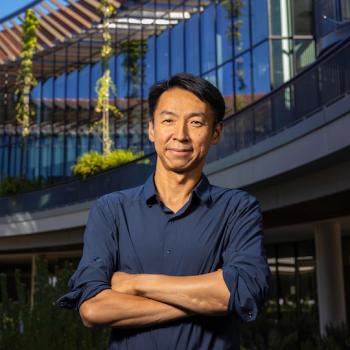
Kang Shen is the Frank Lee and Carol Hall Professor of biology and professor of pathology at Stanford University, where he serves as the Vincent V. C. Woo Director of the Wu Tsai Neurosciences Institute and affiliated faculty at Stanford Bio-X. His research focuses on neuronal cell biology and developmental neuroscience. He has authored or coauthored more than one hundred journal articles. He received his PhD in cell biology from Duke University.

View Bio
Kang Shen
Kang Shen

Kang Shen is the Frank Lee and Carol Hall Professor of biology and professor of pathology at Stanford University, where he serves as the Vincent V. C. Woo Director of the Wu Tsai Neurosciences Institute and affiliated faculty at Stanford Bio-X. His research focuses on neuronal cell biology and developmental neuroscience. He has authored or coauthored more than one hundred journal articles. He received his PhD in cell biology from Duke University.

Access the Complete Report

Read the complete report.

Explore

Date Range
CONTENT TYPE

Select Content Type

  • News
  • Article
  • Videos
  • Podcasts
  • Events
AUTHORS

Select Author

  • Condoleezza Rice
  • John Taylor
  • Jennifer Widom
  • Amy Zegart
  • Herbert Lin
  • Hon. Jerry McNerney
  • Hon. Robert Gates
  • Hon. Steven Chu
  • Hon. Susan M. Gordon
  • John Hennessy
  • Lloyd B. Minor
  • Mary Meeker
  • Peter Scher
  • Thomas M. Siebel
  • Zhenan Bao
  • Dan Boneh
  • Yi Cui
  • Simone D’Amico
  • Drew Endy
  • Siegfried Glenzer
  • Mark A. Horowitz
  • Fei-Fei Li
  • Allison Okamura
  • Kang Shen
  • Eric Schmidt
  • Steven Koonin
  • Sally Benson
  • Norbert Holtkamp
  • Martin Giles
  • Jon Simon
FOCUS AREAS

Neuroscience

  • Artificial Intelligence
  • Biotechnology and Synthetic Biology
  • Sustainable Energy Technologies
  • Cryptography
  • Materials Science
  • Neuroscience
  • Nuclear Technologies
  • Robotics
  • Semiconductors
  • Space
  • Technology Test Page
  • Lasers
  • Artificial Intelligence
  • Biotechnology and Synthetic Biology
  • Cryptography
  • Materials Science
  • Neuroscience
  • Robotics
  • Semiconductors
  • Sustainable Energy Technologies
  • Space
  • Artificial Intelligence
  • Biotechnology and Synthetic Biology
  • Cryptography and Computer Security
  • Materials Science
  • Neuroscience
  • Robotics
  • Semiconductors
  • Space
  • Energy Technologies
  • Quantum Technologies
Date (field_date)
Read More
test
Events
Books
The Stanford Emerging Tech Review | DC Launch

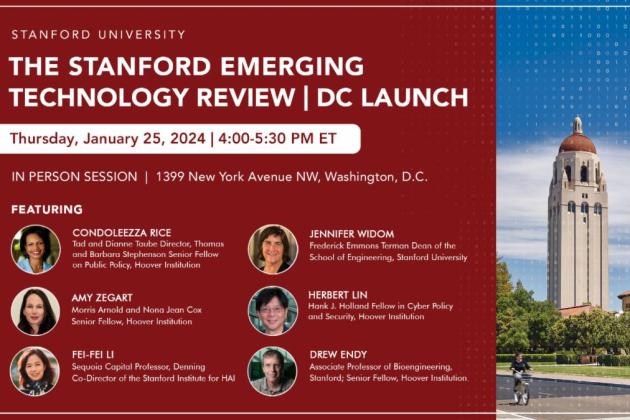
The Hoover Institution and the School of Engineering at Stanford University invite you to the DC launch of the Stanford Emerging Technology Review at the Hoover DC office on Thursday, January 25th, from 4:00 PM - 5:30 PM ET.

January 25, 2024
Read More
Artificial Intelligence
News
Books
Stanford aims to help policy makers prepare for AI, robotics and more

A new project from Stanford University aims to help policymakers get their heads around a range of fast-developing new technologies, from AI and cryptography to robotics and synthetic biology.

December 11, 2023
Read More
Artificial Intelligence
News
Books
Stanford launches emerging-tech project co-led by Hoover Institution’s Condoleezza Rice

Former U.S. Secretary of State Condoleezza Rice is helping lead a new Stanford University initiative to provide “one-stop shopping” for government, businesses and the public to obtain timely information about new and evolving technologies.

December 08, 2023
Read More
Hoover research fellow Herbert Lin, the director and editor-in-chief of the Stanford Emerging Technology Review explains that advancements in a single field of emerging technology leads to advancements in others.
News
Books
Hoover Institution and School of Engineering launch emerging technology review

The Stanford Emerging Technology Review (SETR), a “one-stop-shopping primer” for policymakers on advancements in 10 key emerging technology areas, launched its first report in November.

December 08, 2023
Read More
SETR_SplashScreen_705px.jpg
News
Books
Introducing the Stanford Emerging Technology Review featuring Condoleezza Rice and Jennifer Widom

Introducing the Stanford Emerging Technology Review, an innovative project and publication dedicated to exploring the breakthroughs and policy implications of cutting-edge technologies that are shaping our societies and economies.In this video, the Review’s…

December 05, 2023 by Condoleezza Rice, Jennifer Widom
Read More
Solar
Article
Books
Yi Cui to lead Sustainability Accelerator; Roland Horne named interim Precourt Institute director

Cui has been leading both the Sustainability Accelerator and the Precourt Institute for Energy since April. With Horne transitioning to interim director of the Precourt Institute, Cui will continue engaging with the accelerator’s efforts to generate…

November 10, 2023 by Yi Cui
Read More
Science
Article
Books
Stanford professors promote bio-literacy through digital education

Drew Endy and Jenn Brophy take a step toward educating the world about bioengineering with a course offered to high school students nationwide.

September 27, 2023 by Drew Endy
Read More
AI Robot
Article
Books
Stanford AI professor Fei-Fei Li says we need more human-centered technology. Still, she had to convince herself to share her own story

A human story. Stanford professor Fei-Fei Li is an AI technologist known for her work to make the fast-moving technology more human, a crusade she launched via a widely-read 2018 New York Times op-ed. When she started to write a book, she focused on that work—…

November 15, 2023 by Fei-Fei Li
Read More
Robot
Article
Books
AI is at an inflection point, Fei-Fei Li says

The renowned AI researcher shares her thoughts on the hard problems that lie ahead for the field.

November 14, 2023 by Fei-Fei Li
Read More
Artificial Intelligence
Article
Books
Fei-Fei Li Started an AI Revolution by Seeing Like an Algorithm

Researcher Fei-Fei Li’s ImageNet project provided the feedstock for the deep learning boom that brought the world ChatGPT and other world-changing AI systems.

November 10, 2023 by Fei-Fei Li

You May Also Like

.
Director Rice, Senators Coons, and McCormick in conversation during their panel session.
The 2026 Stanford Emerging Technology Review Debuts In The Nation’s Capital
.
SETR 2026 Cover
2026 Edition Of The Stanford Emerging Technology Review Offers Policymakers And Business Leaders New Insights Into The Implications Of Frontier Technologies.
.
Drone
Technology Applications By Policy Area
.
Globe
Cross-Cutting Themes
.
Binary
Foreword
.
Stanford
Executive Summary
overlay image