







.
AI_133px.jpg
ai
Artificial Intelligence
.
cryptography
crypto
Cryptography
.
materialscience
nano
Materials Science
.
neuroscience
neuroscience
Neuroscience
.
nuclear
nuclear
Nuclear Technologies
.
robotics
robotics
Robotics
.
semiconductor
semiconductors
Semiconductors
.
space
space
Space
.
Sustainable-Energy-Technologies_133px.jpg
energy
Sustainable Energy Technologies

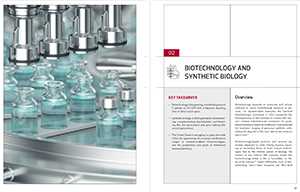
KEY TAKEAWAYS

•   Biotechnology is burgeoning, contributing around 5 percent to the US GDP with a historical doubling time of about seven years. 

•   Synthetic biology is third-generation biotechnology, complementing domestication and breeding (the first generation) and gene editing (the second generation).

•   The United States is struggling to grasp the scale of the bio-opportunity, the strategic ramifications unique to network-enabled biotechnologies, and the possibilities and perils of distributed biomanufacturing.

Icons_card_Biotech.png

Overview

Biotechnology creates products or services in partnership with biology. For example, skin microbes can be engineered to combat skin cancer and essential medicines can be brewed from yeast at industrial scales. Biotechnology, already a huge industry—5 percent of GDP— is expected to grow greatly. Synthetic biology, a subset of biotechnology, builds on genetic engineering to focus on improving the composition and functions of living systems. DNA sequencing and synthesis are two fundamental technologies underlying synthetic biology. DNA sequencers are machines that read or decode specific DNA molecules, while synthesizers write user-specified sequences of DNA. The cost of sequencing a human genome has fallen from $10,000 to around $600 in the last decade, while the cost of gene synthesis dropped from $4/base (2003) to $0.04/base (2023).


Key Developments

Synthetic biology has applications in medicine, agriculture, manufacturing, and sustainability. DNA and RNA synthesis underlie all mRNA vaccines, including those for COVID-19. Synthetic biology can also cultivate drought-resistant crops and enable cells to be programmed to manufacture medicines or fuel on an agile, distributed basis. 

The “superpower” of the internet—the ability to rapidly move information—can amplify the “superpower” of biology: the ability to grow and assemble complex objects locally. For example, DNA sequencers and synthesizers connected to the internet could routinely allow researchers to distribute vaccines against viruses around the world faster than a pandemic can spread. Developed wisely, such capabilities could lead to biodefense and public health systems operating at light speed. Ignored or mismanaged, such capabilities could result in widespread access to bioterror capabilities or worse. Artificial intelligence will likely supercharge synthetic biology, starting with molecular, pathway, and cellular design.
Over the Horizon

For biology to develop fully as a technology, careful attention and sustained support for improving the methods underlying biotechnology overall are essential. Whoever develops the tools for measuring, modeling, and making with biology has a chance of being world leading. Whoever first unlocks routinization and coordination of labor in biotechnology workflows and commercialization will cement their leadership. Careful consideration of such needs and opportunities reveals gaps in the nation’s portfolio (e.g., the National Institute of Standards and Technology should be resourced to develop and advance standards and reference materials undergirding a networked bioeconomy). 

The building blocks for a federal strategic vision released in 2022 (including the National Engineering Biology Research and Development Initiative, National Biotechnology and Biomanufacturing Initiative, National Security Memorandum 15, and National Security Commission on Emerging Biotechnology) tend to focus on applications and outcomes. Yet each offers important openings for creating support for foundational bioengineering research; these opportunities must be seized via active multilateral efforts to provide advice and input. The recently launched Global Forum on Technology at the Organisation for Economic Co-operation and Development (OECD) offers an important additional platform for coordination among democracies.

“Patient capital,” both private and public, is crucial for foundational research, since many biotechnologies have long development scales. Such long-term capital must be sustained in times of ebb and flow in the pace of scientific advancement. Although mRNA vaccines came into widespread public knowledge in 2021, their history began thirty years ago, a history that offers humbling lessons regarding lack of vision and support among institutions and programs now happy to claim credit for success. 

From a strategic perspective, we are tracking four areas of significant consequence and opportunity: 
(1) progress toward constructing life from scratch (e.g., building a cell); 
(2) advances in electrobiosynthesis (i.e., growing biomass starting from renewable electricity and atmospheric carbon); 
(3) advances in next-generation DNA synthesis, including a potential return to desktop synthesis; and 
(4) progress toward profitability (e.g., when synthetic biology companies realize and sustain significant profits). 


REPORT PREVIEW: Biotechnology Synthetic Biology

Faculty Council Advisor

drew-endy_profilephoto.jpg
Drew Endy
Author
Drew Endy

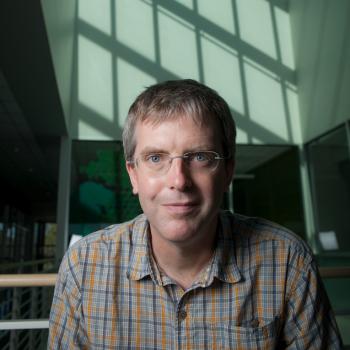
Drew Endy is the Martin Family University Fellow in Undergraduate Education (bioengineering), codirector of degree programs for the Hasso Plattner Institute of Design (the d.school), core faculty at the Center for International Security and Cooperation (CISAC), and senior fellow (courtesy) of the Hoover Institution at Stanford University. He serves as president and director of the Biobricks Foundation and director of the iGEM Foundation and the Biobuilder Educational Foundation. His research focuses on the foundations of synthetic biology along with broader societal aspects. He earned a PhD in biotechnology and biochemical engineering from Dartmouth College.

View Bio
drew-endy_profilephoto.jpg
Drew Endy

Drew Endy is the Martin Family University Fellow in Undergraduate Education (bioengineering), codirector of degree programs for the Hasso Plattner Institute of Design (the d.school), core faculty at the Center for International Security and Cooperation (CISAC), and senior fellow (courtesy) of the Hoover Institution at Stanford University. He serves as president and director of the Biobricks Foundation and director of the iGEM Foundation and the Biobuilder Educational Foundation. His research focuses on the foundations of synthetic biology along with broader societal aspects. He earned a PhD in biotechnology and biochemical engineering from Dartmouth College.

Access the Complete Report

Read the complete report.

Explore

Date Range
CONTENT TYPE

Select Content Type

  • News
  • Article
  • Videos
  • Podcasts
  • Events
AUTHORS

Select Author

  • Condoleezza Rice
  • John Taylor
  • Jennifer Widom
  • Amy Zegart
  • Herbert Lin
  • Hon. Jerry McNerney
  • Hon. Robert Gates
  • Hon. Steven Chu
  • Hon. Susan M. Gordon
  • John Hennessy
  • Lloyd B. Minor
  • Mary Meeker
  • Peter Scher
  • Thomas M. Siebel
  • Zhenan Bao
  • Dan Boneh
  • Yi Cui
  • Simone D’Amico
  • Drew Endy
  • Siegfried Glenzer
  • Mark A. Horowitz
  • Fei-Fei Li
  • Allison Okamura
  • Kang Shen
  • Eric Schmidt
  • Steven Koonin
  • Sally Benson
  • Norbert Holtkamp
  • Martin Giles
  • Jon Simon
FOCUS AREAS

Biotechnology and Synthetic Biology

  • Artificial Intelligence
  • Biotechnology and Synthetic Biology
  • Sustainable Energy Technologies
  • Cryptography
  • Materials Science
  • Neuroscience
  • Nuclear Technologies
  • Robotics
  • Semiconductors
  • Space
  • Technology Test Page
  • Lasers
  • Artificial Intelligence
  • Biotechnology and Synthetic Biology
  • Cryptography
  • Materials Science
  • Neuroscience
  • Robotics
  • Semiconductors
  • Sustainable Energy Technologies
  • Space
  • Artificial Intelligence
  • Biotechnology and Synthetic Biology
  • Cryptography and Computer Security
  • Materials Science
  • Neuroscience
  • Robotics
  • Semiconductors
  • Space
  • Energy Technologies
  • Quantum Technologies
Date (field_date)
Read More
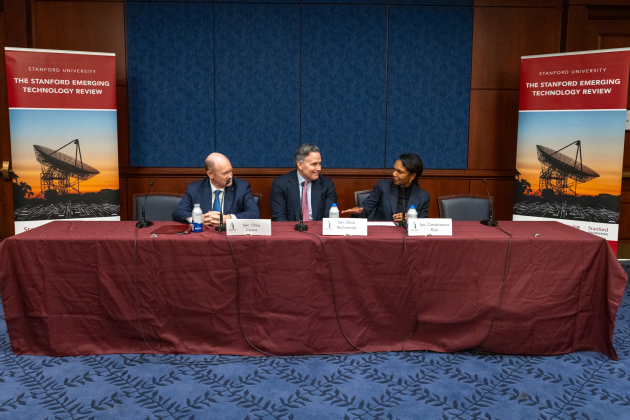
Director Rice, Senators Coons, and McCormick in conversation during their panel session.
News
Books
The 2026 Stanford Emerging Technology Review Debuts In The Nation’s Capital

Senators Chris Coons (D-DE) and Dave McCormick (R-PA) joined Hoover Institution Director Condoleezza Rice, Stanford School of Engineering Dean Jennifer Widom, Senior Fellow Amy Zegart, and contributing scholars at an event in the US Capitol on January 28 to…

February 04, 2026
Read More
SETR 2026 Cover
News
Books
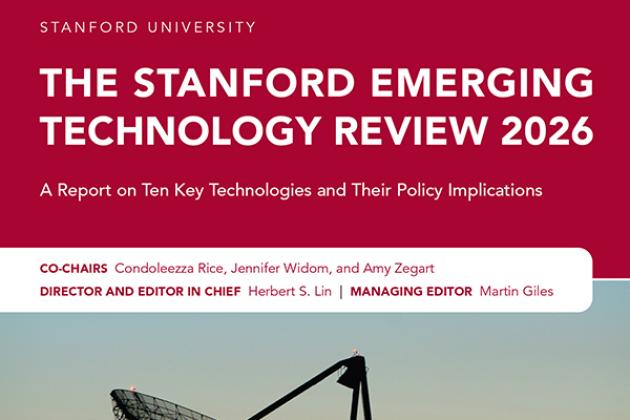
2026 Edition Of The Stanford Emerging Technology Review Offers Policymakers And Business Leaders New Insights Into The Implications Of Frontier Technologies.

The 2025 edition of the Stanford Emerging Technology Review (SETR) report is now available, offering American policymakers a comprehensive overview of how ten frontier technologies, from artificial intelligence to robotics, are transforming the world.

January 26, 2025
Read More
Drone
Article
Books
Technology Applications By Policy Area

This chapter explores applications from each of the ten technology fields described in the report as they may relate to five important policy themes: economic growth, national security, environmental and energy sustainability, health and medicine, and civil…

February 07, 2025
Read More
Globe
Article
Books
Cross-Cutting Themes

One of the most important and unusual hallmarks of this moment is convergence: emerging technologies are intersecting and interacting in a host of ways, with important implications for policy. This chapter identifies themes and commonalities that cut across…

February 07, 2025
Read More
Binary
Article
Books
Foreword

Emerging technologies are transforming societies, economies, and geopolitics. Never have we experienced the convergence of so many technologies with the potential to change so much, so fast, and at such high stakes. This report is intended to help readers…

Read More
Stanford
Article
Books
Executive Summary

This report offers an easy-to-use reference tool that harnesses the expertise of Stanford University’s leading science and engineering faculty in ten major technological areas: artificial intelligence, biotechnology and synthetic biology, cryptography and…

January 26, 2026
Read More
SETR_booklet_2026_cover.jpg
Events
Books
The Stanford Emerging Technology Review 2026

The Hoover Institution and the School of Engineering at Stanford University invite you to the DC launch of the 2026 Stanford Emerging Technology Review on Wednesday, January 28th, from 4:00 PM - 7:00 PM ET.

January 28, 2026
Read More
Lasers
Article
Books
Lasers: Useful and Ubiquitous

In peace and war, the technology continually finds new applications.

August 27, 2025
Read More
SETR Lasers Video
News
Books
The Future of Laser Technology

From eye surgery to missile defense, lasers have become an invaluable technology reshaping medicine, communications, manufacturing, and national security. Sound policy is needed to balance innovation, dual-use risks, and U.S. competitiveness in the laser age.

August 27, 2025 by Siegfried Glenzer
Read More
The Future of Robotics
News
Books
The Future of Robotics

From autonomous machines in construction to wearable robotics in eldercare, robotics is transforming the physical economy, reshaping the future of work, defense, and human-machine interaction. Strategic leadership is needed to harness robotics innovation,…

August 05, 2025 by Allison Okamura

You May Also Like

.
Molecular Structure Conceptual stock photo
Biotechnology: Reshaping Nature And Life Itself
.
technologyabstract
The Care and Feeding of Transformative Tech
.
SETR Synthetic Bio Video
The Future Of Synthetic Biology
.
Drone
Technology Applications By Policy Area
.
Globe
Cross-Cutting Themes
.
Binary
Foreword
.
Mirror
A new report warns of serious risks from ‘mirror life’
.
Artificial Intelligence
Stanford aims to help policy makers prepare for AI, robotics and more
.
Artificial Intelligence
Stanford launches emerging-tech project co-led by Hoover Institution’s Condoleezza Rice
.
Hoover research fellow Herbert Lin, the director and editor-in-chief of the Stanford Emerging Technology Review explains that advancements in a single field of emerging technology leads to advancements in others.
Hoover Institution and School of Engineering launch emerging technology review
.
Science
Stanford professors promote bio-literacy through digital education
.
Drone
Technology Applications By Policy Area
.
Globe
Cross-Cutting Themes
.
Stanford
Executive Summary
.
Binary
Foreword
overlay image